LangSmith Managed Deep Agents: 5 Production Trade-offs
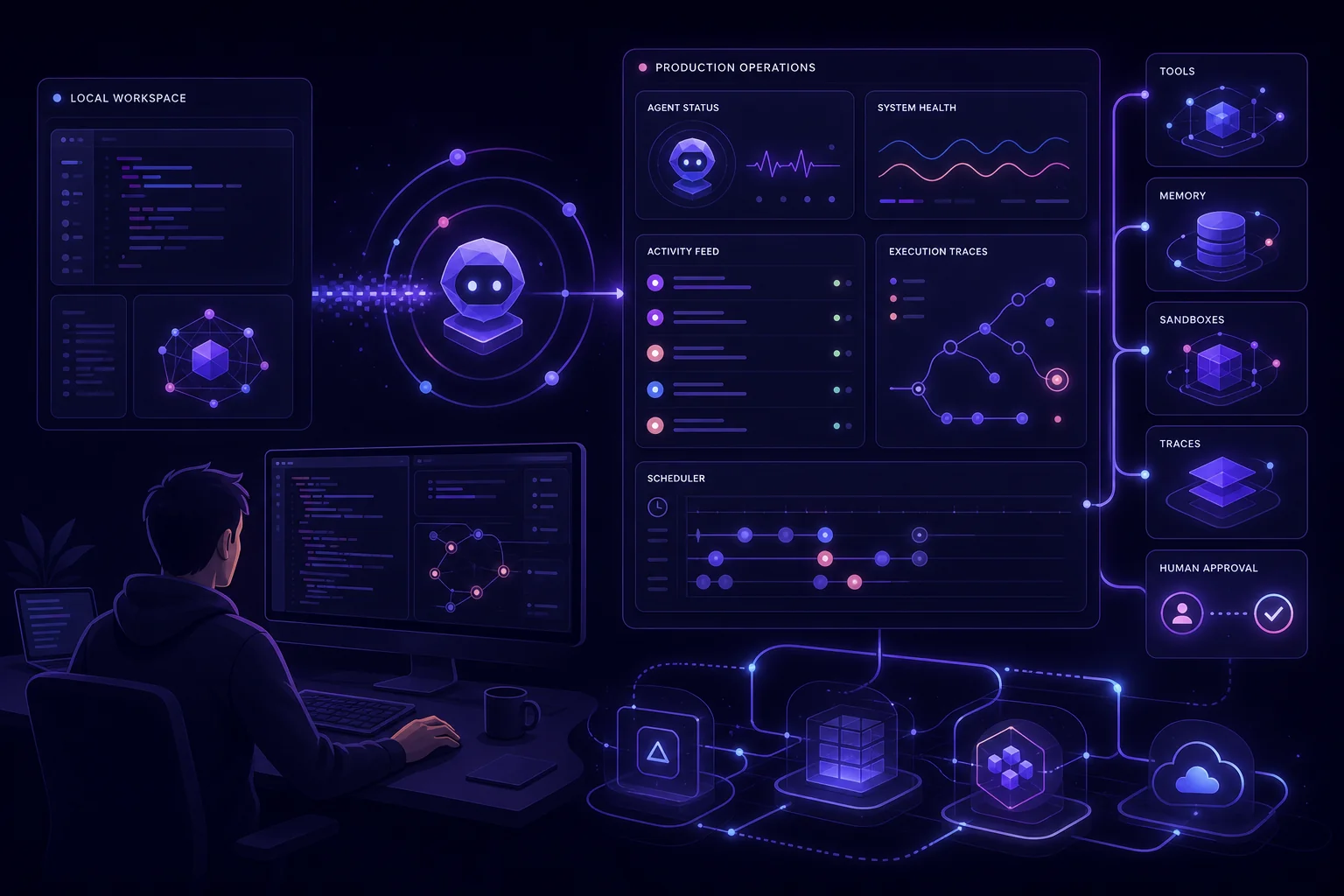
LangSmith Managed Deep Agents gives you a hosted path from local agent code to a production runtime. It also moves important operational decisions into a managed platform. That can remove infrastructure work, but it does not remove your responsibility for authentication, cost control, isolation, or failure recovery.
The practical question is not whether managed hosting is better. It is whether its boundaries match your agent. Compare Managed Deep Agents with a deployment you operate across control, observability, cost, isolation, and recovery.
What LangSmith Managed Deep Agents Actually Manages
Managed Deep Agents, or MDA, is a hosted runtime in LangSmith for code-first Deep Agents written in Python or TypeScript. It uses the open source Deep Agents harness rather than replacing it with a separate agent model.
The documented development path is direct:
You can also deploy from a GitHub repository connected to LangSmith.
The managed layer combines the Deep Agents harness with:
- Durable executions
- Sandboxes
- Instructions and skills managed through Context Hub
- Memory
- Traces
- Hosted LangGraph deployment
Its documented capabilities also include external connections, Model Context Protocol servers, schedules, channels, evaluations, and human interruptions.
This is a broader runtime decision than choosing an agent library. If you are still deciding where Deep Agents fits beside lower-level frameworks, start with this Deep Agents, LangChain, and LangGraph comparison.
There is an important deployment constraint. MDA is in public beta and runs only on LangSmith Cloud in the United States. Treat that as an architecture input, not a footnote.
Before implementation, define what the agent does and who or what communicates with it. Include the channel. A scheduled research agent, a support interface, and a GitHub-connected coding agent require different triggers, identities, and failure handling.
1. Control: Managed Defaults vs a Deployment You Operate
MDA reduces the runtime surface your team must operate. You do not start by assembling execution infrastructure, persistence, tracing, and sandbox support yourself.
The trade-off is control.
The MDA documentation recommends considering a standard LangSmith deployment when your agent requires:
- Custom HTTP routes
- Custom authentication
- Stronger isolation
- Maximum scalability
- A region outside the United States
A deployment you operate can also give you explicit control over network paths, runtime configuration, release policies, and infrastructure boundaries. That control creates work. Your team must build, patch, monitor, and document those components.
Authentication needs particular attention. A separately operated backend can sit in front of MDA, authenticate callers, and forward approved identity headers. A basic request path then looks like this:
Client
  -> Your authentication backend
  -> Validated identity headers
  -> Managed Deep Agent
  -> Approved tools and connections
This pattern keeps user authentication in a component you control. It also means you now operate part of the request path. You must decide how identity headers are created, validated, and prevented from being supplied directly by untrusted callers.
Use MDA when its interface and managed defaults fit the application. Choose a standard LangSmith or self-operated deployment when runtime customization is a hard requirement. The broader managed versus self-hosted agent hosting guide can help frame that ownership decision.
2. Observability: Faster Feedback Loops, Not Just More Logs
An autonomous agent rarely fails with one clean exception. It can retrieve the wrong context, select the wrong tool, pass malformed arguments, or finish with a plausible but incorrect result.
LangSmith traces let you inspect:
- Model calls
- Retrieved context
- Tool behavior
- Latency
- User feedback
- Evaluation scores
The production experience changes when those signals share a trace. You can move from “the run produced a bad answer” to inspecting the steps that produced it.
In a home-built stack, you need to assemble that view. Application logs alone are not enough. You need run identifiers, structured tool events, model metadata, trace correlation, dashboards, and alerting. You must also ensure that asynchronous steps preserve the same execution identity.
LangSmith distinguishes between offline and online evaluations. Offline evaluations compare a new version against known examples before release. Online evaluations score real traffic after deployment. They solve different problems.
A practical release workflow is:
- Keep a versioned regression dataset for representative tasks.
- Run offline evaluations against the candidate agent.
- Inspect traces for changed tool selection and retrieved context.
- Compare the candidate with the deployed version.
- Require human approval for risky behavioral changes.
- Deploy, then apply online evaluations to production traffic.
- Feed reviewed failures back into the regression dataset.
Do not gate a release on one aggregate score alone. Inspect the traces behind regressions. An unchanged final answer can still hide additional tool calls, worse latency, or unsafe behavior.
For a deeper view of how traces, datasets, evaluations, and deployment connect, see the LangSmith agent reliability loop.
3. Costs: Compare Total Operating Cost, Not an Imaginary Price Tag
The supplied MDA sources do not provide pricing or a cost-calculation method. That means there is no evidence here for claiming that MDA or self-hosting is cheaper.
Build a worksheet using measurements from your own workload:
| Cost area | Managed Deep Agents | Deployment you operate |
|---|---|---|
| Platform or infrastructure | Managed platform charges | Compute, network, queue, database, and storage |
| Models and tools | Model and external API usage | Model and external API usage |
| State | Memory, files, and retained traces | Databases, object storage, backups, and retention |
| Observability | Included capabilities plus configured retention | Logging, tracing, dashboards, and alerting |
| Delivery | Agent integration and release work | Build, provisioning, deployment, and release work |
| Operations | Platform integration and incident response | Patching, scaling, on-call work, and incident response |
| Unused capacity | Measure from billing data | Measure idle workers and reserved resources |
Track cost per completed run rather than cost per invocation. A failed execution that retries tools and model calls still consumes resources.
Also separate variable usage from engineering labor. A managed premium may be reasonable when it removes enough deployment and operational work. A self-operated runtime may fit stable, predictable workloads where your team can use infrastructure efficiently. Neither conclusion follows without workload data.
Record at least these fields for each run:
{
  "run_id": "research-2026-10-13",
  "status": "completed",
  "model_cost": null,
  "tool_cost": null,
  "storage_cost": null,
  "platform_or_compute_cost": null,
  "operator_minutes": null
}
Populate the fields from actual invoices, usage exports, and incident records. Do not estimate away failed runs or operator time. For a fuller accounting model, use the production agent cost framework.
4. Isolation and Identity: Treat Sandboxes and Connections as Boundaries to Verify
MDA documents sandboxes, managed connections, MCP servers, memory, schedules, channels, and human interruptions. These are useful primitives. Their presence does not tell you every property of their security boundary.
A managed connection can link an agent to an external service such as GitHub, Notion, or Tavily. The secret identifier is stored in the LangSmith workspace. Before production, verify how that design maps to your access model.
Ask concrete questions:
- Which tools can each agent invoke?
- What network destinations can a sandbox reach?
- What permissions does each external connection receive?
- How are connection scopes restricted?
- How are secrets rotated?
- How are development and production environments separated?
- Which users can create or modify connections?
- What access records are available for review?
- Can memory or files cross an unintended agent boundary?
- What happens to sandbox data after execution?
Do not fill undocumented details with assumptions. Test them or request specific documentation.
A home-built deployment makes the same questions your implementation responsibility. You must configure identities, secret storage, egress rules, runtime isolation, environment separation, and access logging. More control is useful only if you apply it consistently.
For both paths, start with least privilege. Give a reporting agent read access where possible. Put writes behind narrow tools. Require human interruption before consequential operations. Review the broader production agent security model before connecting real systems.
5. Recovery After Errors: Durable Execution Is a Starting Point, Not a Recovery Contract
MDA documents durable executions. LangSmith also describes durable threads, state, streaming, and workflows with human approval.
The supplied sources do not specify retry policies, backoff behavior, idempotency guarantees, partial-failure handling, or exact resume semantics. You still need to validate what “durable” means for your workflow.
Build a failure matrix before launch:
| Failure | Expected behavior | Evidence to collect |
|---|---|---|
| Tool timeout | Stop, retry, or request intervention | Trace and final run state |
| Runtime interruption | Resume from an accepted checkpoint | Completed steps after restart |
| Duplicate event | Avoid duplicate side effects | Stable event or run identifier |
| External write succeeds but response fails | Reconcile before retrying | External operation identifier |
| Human approval is delayed | Preserve state safely | Resumed thread and pending action |
| Run is replayed | Produce safe, defined behavior | Idempotency test result |
For writes, use an idempotency key: a stable identifier that lets the receiving system recognize a repeated operation. Persist it before making the external change.
import hashlib
import json


def idempotency_key(run_id: str, operation: str, payload: dict) -> str:
    canonical = json.dumps(payload, sort_keys=True, separators=(",", ":"))
    raw = f"{run_id}:{operation}:{canonical}"
    return hashlib.sha256(raw.encode()).hexdigest()


payload = {"repository": "example/project", "label": "needs-review"}
print(idempotency_key("run-example", "apply-label", payload))
Send that key with the tool request when the external API supports it. Otherwise, store it in your own operation ledger and check the external state before repeating a write.
A self-operated stack requires explicit checkpoints, retry policies, idempotency handling, and runbooks. MDA may supply managed durability primitives, but your proof-of-production must confirm their behavior for your tools. These guides on resumable agent tasks and idempotent Python jobs cover the application-level patterns.
Which Production Path Should You Choose?
Use this decision matrix as a starting point:
| Criterion | Favor MDA when | Favor another deployment when |
|---|---|---|
| Control | Managed interfaces fit the agent | You need custom routes, authentication, runtime policy, scale, or another region |
| Observability | Integrated traces and evaluations reduce integration work | You need an independently operated telemetry stack |
| Cost | Measured operational savings justify platform charges | Your measured workload favors infrastructure you operate |
| Isolation | Verified sandbox and connection boundaries meet your needs | You require stronger or separately verified controls |
| Recovery | Tested durable behavior satisfies the workflow | You need explicit control over checkpoints, retries, and resume semantics |
MDA offers a direct managed path to Deep Agent execution with traces, memory, connections, sandboxes, and durable workflows. Its US-only public beta status and documented customization limits may rule it out for some systems.
Before committing, run a proof-of-production workload. Measure latency, cost per completed run, recovery behavior, isolation boundaries, and operator effort. The right platform is the one whose behavior you have verified—not the one with the shortest deployment demo.