Deep Agents vs LangChain vs LangGraph: 5-Criteria Guide
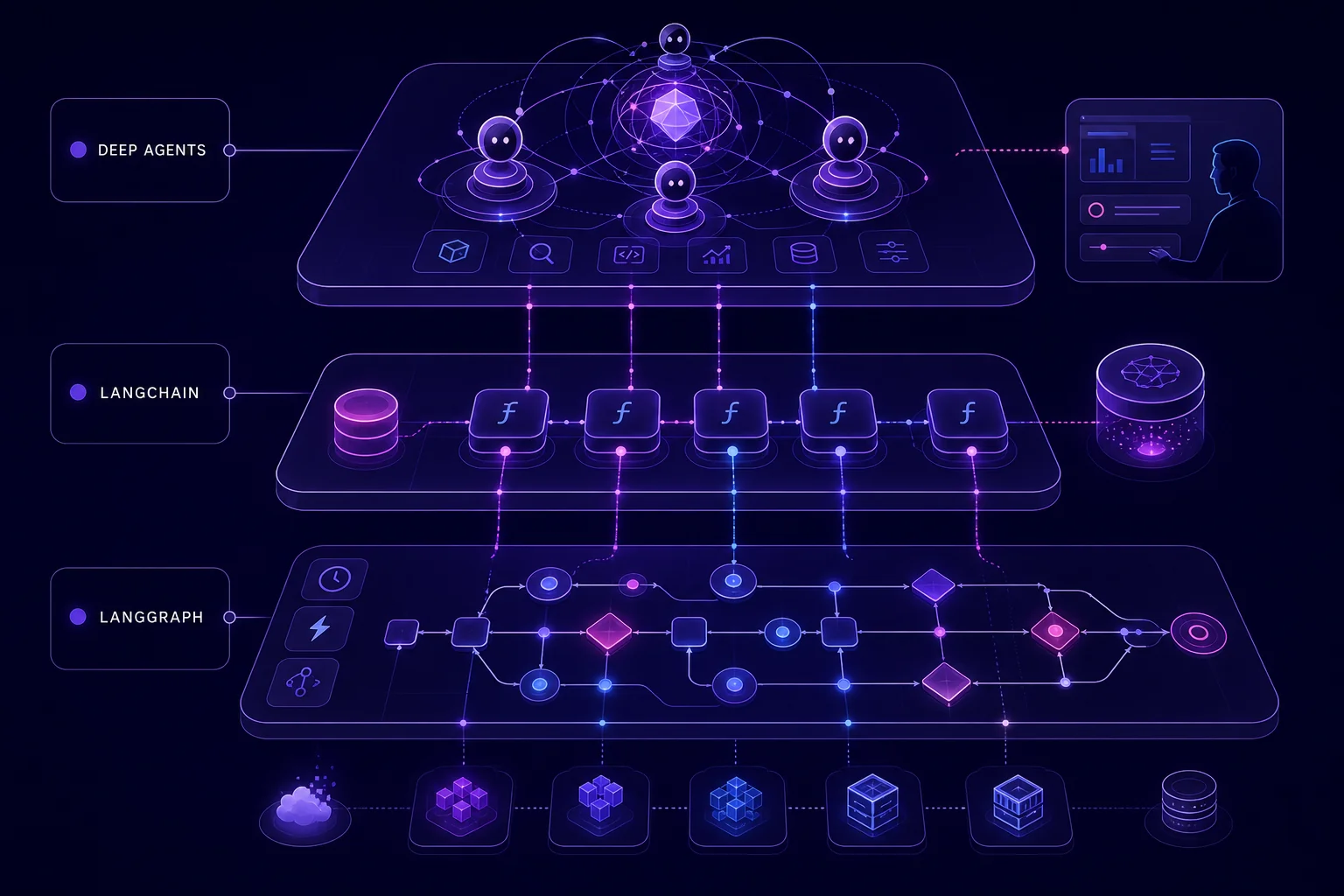
Deep Agents, LangChain, and LangGraph are different layers of the same stack. Deep Agents is a higher-level harness. LangChain is an agent framework. LangGraph is a lower-level runtime. Choosing between them depends less on your prompt and more on how you need the agent to run, recover, and evolve.
This guide compares them on one workflow and five criteria: orchestration, state and recovery, extensibility, observability, and operational cost.
Orchestration: Compare the Same GTM Account-Research Workflow
Consider a weekly go-to-market workflow:
- Load an account from your CRM.
- Search its call transcripts.
- retrieve relevant news.
- Prepare a quarterly business review brief.
- Ask a sales representative to approve it.
- Publish the approved report.
The framework choice changes how you express those steps.
LangChain: a tool-calling loop
LangChain provides a minimal, lightly opinionated agent abstraction. A language model runs in a loop, selects tools, inspects their results, and decides whether to continue.
For this workflow, you might expose these tools:
TOOLS = {
    "get_crm_history": get_crm_history,
    "search_transcripts": search_transcripts,
    "search_news": search_news,
    "save_qbr_draft": save_qbr_draft,
}
The model decides which tool to call and in what order. This is a good fit when the path can remain dynamic. It also keeps the initial implementation small.
The trade-off is that your system prompt and middleware carry more responsibility. If CRM retrieval must always precede report generation, you need to enforce that rule rather than assume the model will follow it.
Deep Agents: planning, skills, and delegation
Deep Agents adds a more opinionated harness around the base LangChain agent. It includes planning, filesystem-based context management, skills, sub-agents, and memory that can be used across runs.
The QBR workflow maps naturally to those features:
- A research sub-agent examines CRM history.
- Another sub-agent searches transcripts and news.
- A QBR skill applies the recurring report process.
- The filesystem stores intermediate research.
- Cross-run memory retains context relevant to a salesperson.
The published GTM example uses the same patterns. It includes per-salesperson memory, QBR preparation skills, and sub-agents that research call transcripts, news, and CRM history.
You configure a Deep Agent through create_deep_agent, passing a model, tools, a system prompt, and skills. This gives you more behavior out of the box than a minimal tool loop.
LangGraph: an explicit workflow
LangGraph represents the process as a graph. Nodes perform work. Transitions determine what runs next.
For example:
load_account
      |
      v
research_crm ----\
research_calls ---+--> validate_evidence --> draft_qbr
research_news ----/                           |
                                              v
                                      request_approval
                                         /        \
                                    approved     rejected
                                       |            |
                                    publish      revise
This structure encodes deterministic requirements directly. It also gives human approval a defined position in the workflow.
LangGraph is the better fit when you must know which step ran, which branch was selected, and where execution stopped. Its cost is additional workflow design and a steeper learning curve.
These options are composable. LangGraph powers the abstractions used by LangChain and Deep Agents. You can start with a higher-level harness and move specific paths into a custom graph when you need tighter control.
State and Recovery: Persistence, Checkpoints, and Resuming Work
Now apply the same failure cases:
- The model times out during news research.
- The QBR job stops after retrieving transcripts.
- A human rejects the draft.
- The scheduler retries a partially completed run.
LangChain
A basic LangChain agent loop does not, by itself, define your complete production recovery policy. Your application must decide what to persist, how to identify a run, and whether a retried tool call is safe.
For the QBR agent, persist at least:
{
  "run_id": "qbr:account-id:period",
  "status": "researching",
  "completed_steps": ["crm", "transcripts"],
  "artifacts": {
    "crm_result": "storage-key",
    "transcript_result": "storage-key"
  },
  "approval": null
}
On retry, load this record and skip completed work. Middleware can add deterministic behavior around the loop, but the persistence boundary remains an application and deployment concern.
Deep Agents
Deep Agents supplies a filesystem for context and memory that can survive across executions. That reduces the amount of context plumbing needed for research-heavy agents.
You still need to define artifact ownership and retry semantics. Filesystem context does not automatically make an external CRM write idempotent. If the approval step is retried, use a stable run identifier and an upsert rather than creating another report.
LangGraph
LangGraph is built around durable execution, fault tolerance, human intervention, and step-level observability. Its graph structure gives recovery a clear unit: the node.
If news retrieval fails, the runtime can identify that stage without treating the entire QBR workflow as an opaque loop. A rejection can transition to a revision node while retaining earlier research.
For a practical implementation, see the guide to deploying LangGraph with persistent checkpoints. If your runtime has a hard execution limit, use the same staged approach described in resumable AI agent task design.
In all three cases, separate framework state from deployment state. The framework tracks agent progress. Your hosting layer still needs durable storage, retries, timeouts, and stable run identifiers.
Extensibility: Tools, Middleware, Skills, and Custom Workflows
The next version of the agent may need a new CRM API, vector search, citation validation, and a custom report renderer.
LangChain extends primarily through tools, integrations, and middleware. Middleware hooks can modify the agent loop. For example, you can summarize context when it becomes too large or run a final verification before returning a report.
Deep Agents builds on that model. Skills package recurring workflows. Sub-agents isolate specialized research. The filesystem gives those components a shared context surface. It is useful when the workflow is broad but you do not want to define every transition manually.
LangGraph provides the lowest-level control. You can add a validation node, route insufficient evidence back to research, or require approval before publication. This requires more explicit code, but the resulting behavior is easier to inspect.
A practical progression is:
LangChain tool loop
    -> add middleware and validation
    -> adopt Deep Agents for planning, skills, or sub-agents
    -> move strict paths into a LangGraph workflow
You do not need a permanent, stack-wide choice. LangChain can assemble integrations inside custom graphs. Deep Agents itself relies on LangGraph. Use the highest abstraction that preserves the control your workflow requires.
Observability: Trace the Same Run from Trigger to Approval
Use the same observability checklist regardless of framework:
- Trigger and run identifier
- Model calls
- Tool calls and exit status
- Retrieved evidence
- State transitions
- Retry attempts
- Latency
- Token usage
- Approval outcome
- Failed step or node
- Final artifact location
LangGraph’s durable runtime is designed for observability at each step. Its explicit nodes give logs and traces natural boundaries such as research_news or request_approval.
A LangChain trace is more likely to center on the model-and-tool loop. Add structured events around business operations so you can distinguish “the model called a tool” from “the CRM record was updated successfully.”
Deep Agents adds another level to trace. Record which skill ran, which sub-agent produced an artifact, and which filesystem or memory entry informed the final brief.
Do not assume that framework tracing replaces infrastructure monitoring. Your deployment layer still needs to record scheduling failures, process exits, resource limits, and missing secrets. The Python agent observability guide covers logs, traces, monitoring, and dashboards independently of framework choice.
Redact sensitive CRM and transcript content. Store references to evidence where possible instead of copying complete inputs into every log event.
Operational Cost: Infrastructure, Runs, Storage, and Maintenance
Framework licenses are not the useful comparison here. Model usage, tool calls, storage, tracing, runtime duration, retries, and engineering time dominate the operational design.
Use a cost model rather than assuming one framework is always cheaper:
from dataclasses import dataclass

@dataclass
class WeeklyCost:
    runs: int
    model_cost_per_run: float
    tool_cost_per_run: float
    runtime_cost_per_run: float
    storage_and_tracing: float
    maintenance: float

    def total(self) -> float:
        variable = self.runs * (
            self.model_cost_per_run
            + self.tool_cost_per_run
            + self.runtime_cost_per_run
        )
        return variable + self.storage_and_tracing + self.maintenance
Populate it with your provider invoices and measured run data. Do not estimate from framework names.
Deep Agents can reduce development work for planning, memory, and delegation. Its autonomous behavior may perform more model or tool operations, so set budgets and termination conditions.
LangChain keeps the harness small. It can have a lower conceptual overhead for a simple agent, but custom persistence, approval, and recovery logic become maintenance work as the workflow grows.
LangGraph shifts more effort into explicit workflow construction. It may justify that effort when retries can resume at a failed node instead of repeating expensive research. Checkpoints and detailed traces also consume storage.
The published GTM agent provides useful scale context. It handles nearly 10,000 weekly requests for more than 150 active users. User-initiated traffic accounts for 26% of requests, while background agent tasks account for 74%. It runs on LangSmith Deployments, which supports traffic spikes plus scheduled or event-triggered executions. Those figures are an example, not a pricing benchmark.
For infrastructure decisions, compare the trade-offs between self-hosted and managed agent hosting.
| Criterion | Deep Agents | LangChain | LangGraph |
|---|---|---|---|
| Orchestration | Planning, skills, and sub-agents | Dynamic model-and-tool loop | Explicit nodes and transitions |
| State and recovery | Filesystem context and cross-run memory | Application-defined recovery around the loop | Durable, step-oriented execution |
| Extensibility | Skills, tools, middleware, sub-agents | Tools, integrations, and middleware | Custom nodes, branches, and workflows |
| Observability | Trace skills, sub-agents, and inherited runtime behavior | Trace the loop plus custom business events | Natural step-level trace boundaries |
| Operational cost | Faster harness setup; monitor autonomous work | Small starting surface; more custom operations code | More workflow engineering; precise recovery boundaries |
Deep Agents is the strongest starting point when you want a capable autonomous harness. LangChain fits a lightweight agent that needs custom tools without a large workflow model. LangGraph fits production processes where deterministic routing, recovery, and human approval justify more explicit code.
The hosting layer remains separate from that choice. Whether you use HollowHost or another runtime, require durable state, isolated secrets, scheduled execution, and logs that survive the process. Framework selection defines agent behavior. Production infrastructure determines whether that behavior remains reliable after the first failure.