What Is LangSmith? The Complete Agent Reliability Loop
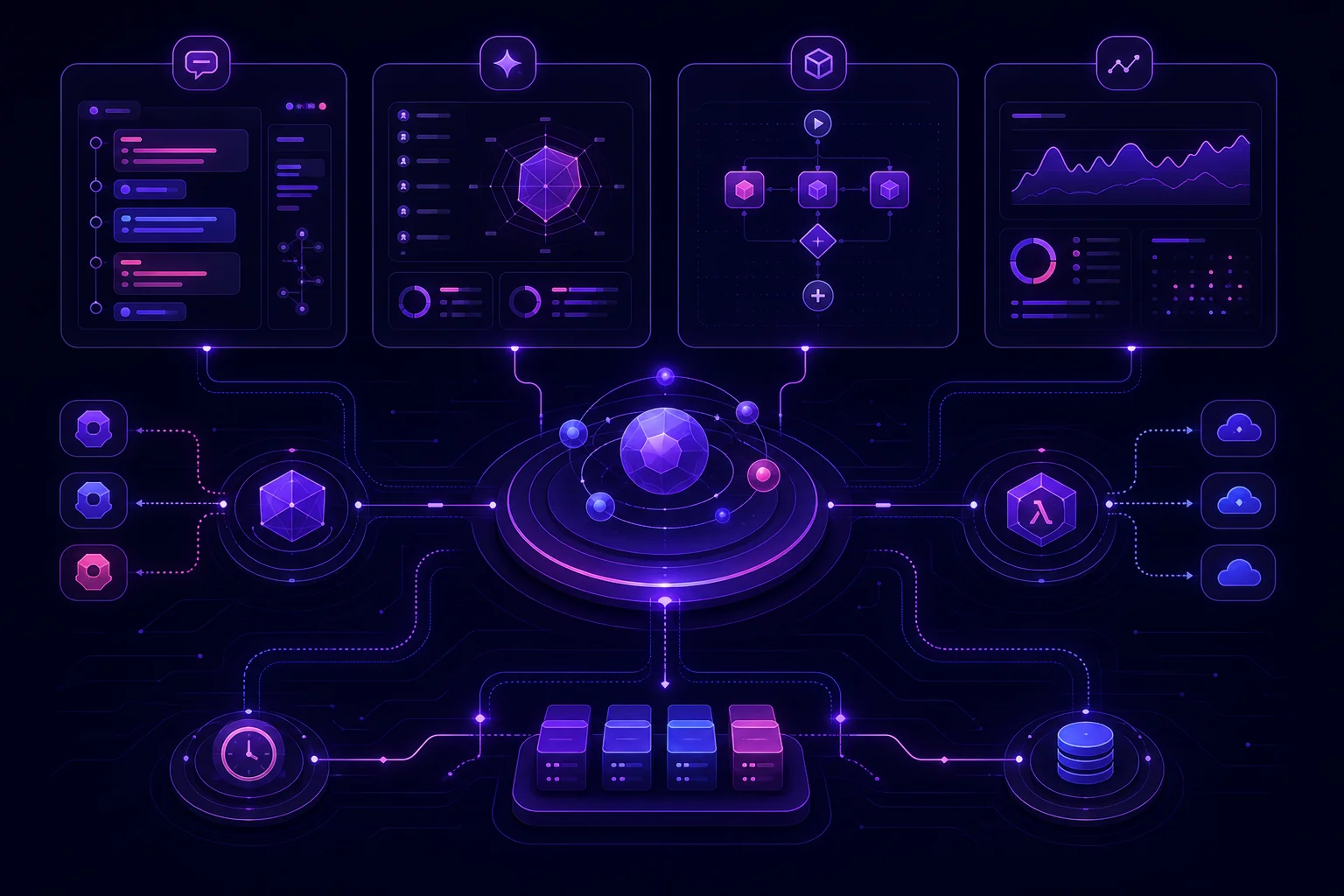
LangSmith is a framework-independent platform for observing, evaluating, and deploying AI agents. Its main value is not a single dashboard. It is the feedback loop between production traces, reusable test cases, evaluations, releases, and live monitoring. When your agent becomes slower, calls the wrong tool, or produces a weak answer, that loop helps you reproduce the failure and test the fix before shipping it.
What Is LangSmith and Who Is It For?
LangSmith describes itself as an agent engineering platform. It covers observability, evaluation, and deployment rather than replacing your agent code.
You can use it with closed models, open models, or a mix of both. You can also build with an agent framework or custom code. That makes LangSmith relevant when your application does not fit neatly into a single framework.
The platform is primarily useful for developers and teams operating applications whose behavior cannot be understood from a final response alone. Examples include:
- A support agent that retrieves account information and calls internal tools.
- A research job that searches approved sources and generates a report.
- A lead-enrichment agent that validates records across several APIs.
- A LangGraph workflow with persistent state and human approval steps.
- A multi-agent system in which several workers coordinate on one task.
In each case, a failed output may have several possible causes. The model may have received the wrong context. A tool may have returned malformed data. The agent may have repeated a step. A prompt change may have altered tool selection.
A standard application log can tell you that the request failed. LangSmith is designed to show the execution path that produced the result.
Traces: See What an Agent Actually Did
A trace represents a complete conversation or agent execution. It exposes the steps inside that execution, such as model requests, retrieval operations, tool calls, and nested agent work.
This distinction matters because the following artifacts serve different purposes:
| Artifact | What it answers |
|---|---|
| Log | What event did the application record? |
| Trace | What execution path produced this result? |
| Dataset | Which reusable inputs and expected behaviors should you test? |
| Evaluation | How well did the agent behave on those cases? |
| Production metric | Is live behavior changing over time? |
Suppose a support agent returns an incomplete answer. Your application log might contain an error status, request ID, and final output. The trace can reveal that the agent called retrieval repeatedly, selected an irrelevant document, and then answered from incomplete context.
LangSmith Observability can track complete runs and conversations. Its production monitoring covers cost, latency, errors, and qualitative metrics generated by online evaluations. Those signals can be displayed in dashboards and connected to alerts.
LangSmith also includes two analysis tools:
- Polly, an integrated assistant intended to help developers understand large traces and identify problems.
- Insights Agent, which is intended to surface usage patterns and recurring failure modes.
These tools do not remove the need for application-level telemetry. Your agent should still emit structured logs, preserve correlation IDs, and report clear exit codes. Traces add the model and tool execution context that ordinary infrastructure logs often lack.
For a framework-neutral implementation pattern, see this guide to logging, tracing, and monitoring Python agents.
A minimal application event can remain simple:
import json
import logging
import uuid

logging.basicConfig(level=logging.INFO, format="%(message)s")

def emit_event(run_id: str, event: str, **fields: object) -> None:
    payload = {
        "run_id": run_id,
        "event": event,
        **fields,
    }
    logging.info(json.dumps(payload, sort_keys=True))

def run_support_agent(question: str) -> str:
    run_id = str(uuid.uuid4())
    emit_event(run_id, "agent.started", question=question)

    answer = "A support response generated from approved documentation."

    emit_event(run_id, "agent.completed", answer=answer)
    return answer

if __name__ == "__main__":
    print(run_support_agent("How do I update my account settings?"))
This code does not replace LangSmith tracing. It gives your hosting runtime a stable run ID that you can correlate with a deeper agent trace.
Datasets and Evaluations: Turn Real Runs Into Tests
A trace helps you inspect a past execution. A dataset turns that execution into a reusable test case.
That transition is central to the reliability loop. Without it, you can fix an observed failure and still have no repeatable way to verify that the same behavior stays fixed.
LangSmith Evaluation can run several kinds of evaluators:
- An LLM acting as a judge.
- A deterministic, code-based grader.
- An evaluator for a multi-turn conversation.
- Human review and annotation by domain experts.
LLM judges can also be calibrated against human preferences. This is important when quality depends on tone, completeness, or relevance rather than an exact string match.
Use code-based graders when the requirement can be expressed deterministically. For example, a support response may need a non-empty citation field or may be forbidden from claiming that an account change has already happened.
from dataclasses import dataclass

@dataclass
class EvaluationResult:
    passed: bool
    reason: str

def grade_support_answer(answer: str) -> EvaluationResult:
    normalized = answer.lower()

    if not answer.strip():
        return EvaluationResult(False, "Answer is empty")

    if "i updated your account" in normalized:
        return EvaluationResult(False, "Claims an action was completed")

    return EvaluationResult(True, "Passed deterministic checks")

if __name__ == "__main__":
    result = grade_support_answer(
        "Open account settings and confirm the change before saving."
    )
    print(result)
Use human annotation when a domain expert must decide whether the output is acceptable. Use an LLM judge when you need scalable qualitative review, but calibrate that judge against human decisions.
LangSmith can compare evaluation results side by side. That lets you measure the effect of a prompt, model, retrieval, or tool change before releasing it. The goal is regression prevention, not merely producing a score.
For a broader testing workflow, read the reproducible AI agent evaluation guide.
The LangSmith Reliability Loop, From Fix to Release
A practical LangSmith workflow connects production and development:
- Capture a failing production trace.
- Inspect the model, retrieval, and tool-call sequence.
- Isolate the step that caused the failure.
- Save the input and required behavior as a dataset example.
- Run repeatable evaluators against the current agent.
- Modify the prompt, tool contract, retrieval logic, or orchestration.
- Compare the old and new evaluation results side by side.
- Promote the change only after your quality gates pass.
- Monitor the released version for live regressions.
Each part has a specific job.
Datasets are reusable cases. They preserve inputs, reference outputs, expected properties, or review criteria.
Evaluations measure behavior. They execute graders against agent outputs.
Monitoring validates production. It tells you whether live traffic still behaves like your test cases suggested it would.
This loop prevents a common failure mode: fixing one prompt after reading one bad output, then shipping without testing adjacent behavior. A local fix may improve the reported case while damaging tool selection, answer completeness, or multi-turn behavior elsewhere.
Your release process should therefore treat evaluation results like other build checks. They are not identical to unit tests, but they can still block a release when required behaviors regress.
A Concrete Production Diagnosis: From Alert to Root Cause
Consider a deployed support agent. It retrieves approved documentation, calls an account-status tool, and writes a response. Production monitoring shows deteriorating latency and qualitative evaluation results.
Start with the affected trace.
You discover that the agent performs retrieval, calls the account tool, and then performs retrieval again with nearly the same query. It repeats this path before producing a vague response. The final answer is only the symptom. The trace exposes the repeated work.
Next, extract the failing request into a dataset. Preserve the expected behavior:
input:
  question: "Why is my account update still pending?"
expected_behavior:
  - "Read the account status once"
  - "Use approved support documentation"
  - "Do not claim the update was completed"
  - "Explain the next user action"
These entries are test requirements for the example, not claims about LangSmith defaults.
Run the current agent against the dataset. Apply a deterministic grader for prohibited claims and tool-call constraints. Add a qualitative evaluator for relevance and completeness. If needed, ask a support specialist to annotate the response.
Then correct the underlying issue. The fix might change the orchestration rule so that a successful account-status result is reused rather than fetched again. It might also make the tool response schema clearer to the model.
Evaluate the corrected version against the full dataset, not just the new case. Use the side-by-side comparison to check whether the change improves the failure without damaging existing behavior.
After deployment, monitor:
- Latency across complete runs.
- Tool and model costs.
- Execution errors.
- Online qualitative evaluation metrics.
- Similar repeated-call patterns in new traces.
This is where observability and evaluation become one process. The alert identifies a live change. The trace explains one execution. The dataset makes it reproducible. Evaluations test the correction. Monitoring validates the release.
If your agent uses durable graph execution, deployment concerns still apply separately. The LangGraph production jobs guide covers checkpoints, recovery, scheduling, and secure secrets.
Deployment, Governance, and When LangSmith Fits
LangSmith also offers a deployment runtime. Its documented capabilities include durable execution, human-in-the-loop validation, background agents, multi-agent coordination, and exactly-once execution. It is presented as supporting long-running agents, irregular workloads, and horizontal scaling.
The platform also provides a centralized registry with version management and rollback. Native protocol support includes A2A, MCP, and Agent Protocol.
Deployment options include:
- LangSmith as SaaS.
- Deployment in the customer’s cloud.
- Self-hosted deployment.
The platform presents data residency options in the United States, Europe, and the APAC region. Identity and access features include SSO/SAML, RBAC/ABAC, and SCIM.
Those capabilities make LangSmith worth considering when you want traces, evaluation, deployment, and governance within one agent engineering platform. They do not remove the need to map your full production architecture.
Before adopting it, verify:
- Compatibility with your frameworks and custom instrumentation.
- Current pricing and quotas.
- Trace retention and deletion behavior.
- Expected tracing volume.
- Evaluation model costs.
- Sampling rules for production traces.
- Access-control requirements.
- Whether its deployment runtime fits your workload.
- Whether you still need a separate scheduler, webhook service, or hosting platform.
The supplied material does not establish current pricing, quotas, or retention terms. Check those details against the current service documentation before designing around them.
Conclusion
LangSmith is best understood as a reliability loop for AI agents. Traces show what happened. Datasets preserve important cases. Evaluations measure changes. Side-by-side comparisons help prevent regressions. Production monitoring tells you whether the released agent still behaves as expected.
That loop works only when it connects to disciplined deployment. Your agent still needs secure secrets, repeatable builds, clear runtime limits, and recovery behavior. Whether you use LangSmith’s deployment runtime or a separate agent hosting platform such as HollowHost, keep the same principle: every production failure should become an observable, reproducible test case rather than a one-off prompt fix.