Database Connection Exhaustion: Cascade Deletion Incident
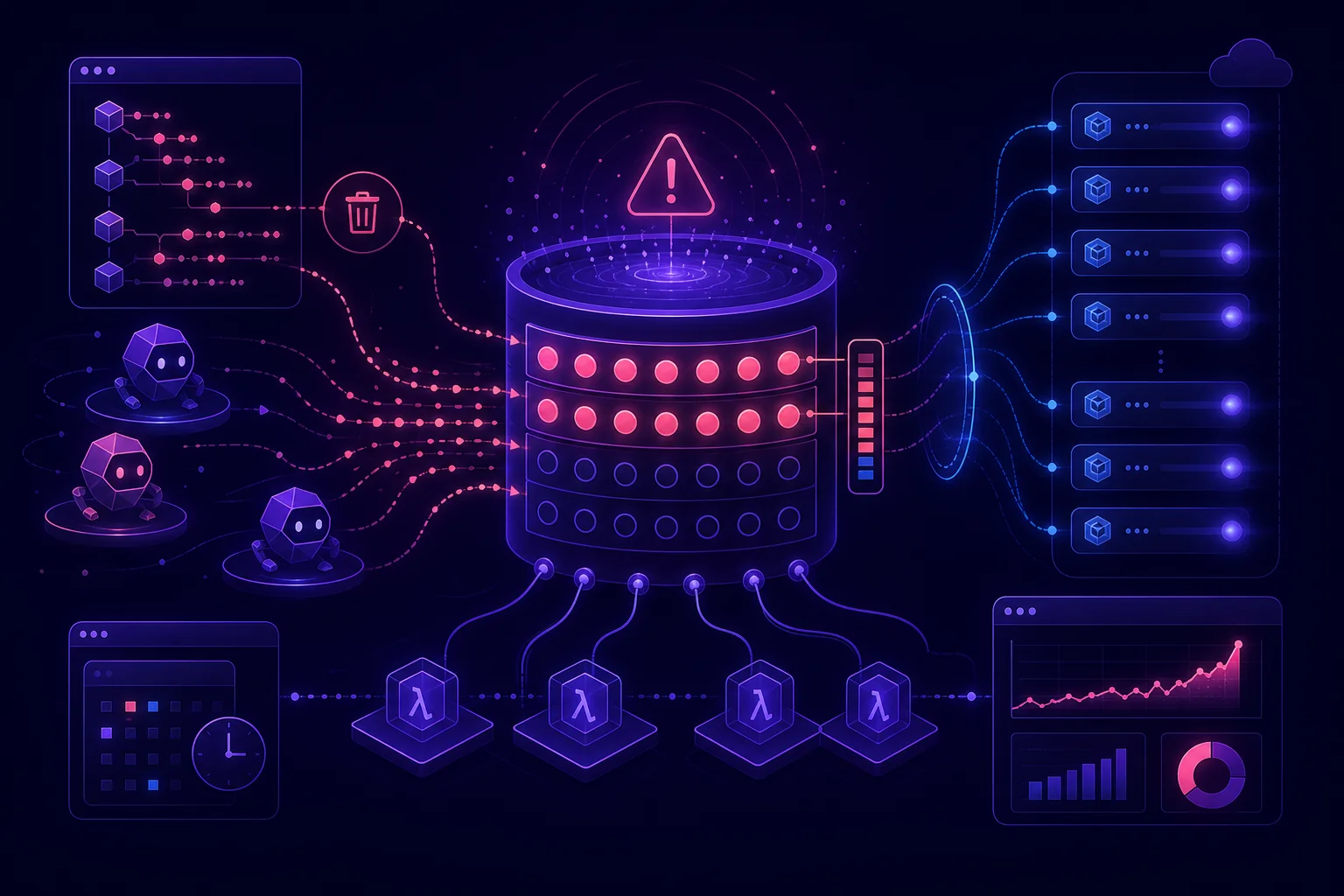
A deletion job can look harmless until one parent row expands into many child-row deletes. Transactions stay open. Locks accumulate. Connections stop circulating. Customer requests wait for the same pool, time out, and retry. The retries add more pressure.
This incident reconstruction follows that failure chain. It is not attributed to a named company. The goal is practical: identify the signals, contain the outage, and redesign deletion jobs so they fail safely.
Incident overview: how cascading deletions became an outage
The incident started with a scheduled cleanup job. Its task was simple: delete expired parent records and their dependent rows.
The database schema allowed a parent deletion to cascade into child tables. That made the application code concise, but it hid the amount of work behind each DELETE. A single application operation could become a much larger database transaction.
The reconstructed failure chain was:
- The cleanup worker deleted parent rows.
- Foreign-key cascades triggered child-row deletions.
- Those deletions held transactions and database connections open.
- Concurrent delete operations contended for locks.
- Connection turnover slowed.
- The application pool reached its limit.
- Customer requests waited for connections.
- Waiting requests timed out.
- Automatic retries increased demand.
- The service could no longer process normal traffic reliably.
This combines documented connection-pool failure modes: timeout and retry cascades, connections that are never returned, and connections that progressively slow because another dependency is slow (source).
The important distinction is between pool capacity and connection circulation. A full pool is not automatically unhealthy. A pool becomes dangerous when connections remain occupied long enough that new work cannot acquire one.
Cascade deletion made that distinction easy to miss. The endpoint issued one deletion request. The database performed the expanded work inside the transaction.
Timeline of the failure: from delete request to connection exhaustion
The exact timestamps for this reconstructed incident are unavailable. The timeline therefore uses relative phases rather than presenting invented measurements.
T+0 — The deletion job starts
The scheduler launches multiple deletion workers. Each worker checks out a database connection and begins deleting parent records.
The job has no explicit limit on the number of child rows processed per transaction. It also lacks a durable checkpoint between bounded units of work.
Deletion transactions expand
The database applies the configured cascade rules. Child-table deletes increase transaction duration. Concurrent workers begin touching related tables and indexes.
Some transactions wait for locks. Their connections remain checked out while they wait.
Connection turnover slows
Connections are now returned less frequently. A connection can remain blocked because of a slow query, a network problem, or a deadlock. When all available connections are occupied, new requests wait rather than execute immediately (source).
Customer traffic and deletion workers compete for the same constrained resource.
Pool acquisition latency rises
Requests spend more time waiting to obtain a connection. The application may still show normal CPU usage because threads or tasks are waiting rather than computing.
A waiting request can expire after 30 seconds, even when logs, CPU, and the database appear normal at first glance (source).
Retries amplify demand
Timed-out operations are retried. If the original transaction is still running or blocked, the retry does not replace the original work. It creates additional demand.
Deletion workers retry. Customer requests retry. Queue consumers may redeliver failed tasks. Every retry competes for the same pool.
Service disruption follows
The cleanup job is no longer isolated from the request path. Health checks, API handlers, agent jobs, and administrative operations can all fail to acquire connections.
A safer design treats deletion as a resumable workflow with bounded concurrency, persisted checkpoints, and explicit retry state. The same concepts appear in this guide to queues, retries, checkpoints, and durable recovery.
Diagnosis: distinguish leaks, locks, slow queries, and retry storms
Start with the pool. Then correlate it with database and worker metrics.
Use this decision tree:
Are active connections at the pool limit?
├── No
│   └── Check query latency, network errors, and database capacity.
└── Yes
    ├── Is acquisition time rising?
    │   └── Confirm pool congestion.
    ├── Are transactions old or waiting on locks?
    │   └── Investigate long deletes and cascade scope.
    ├── Are connections checked out without matching releases?
    │   └── Investigate a connection leak.
    └── Is retry volume increasing after timeouts?
        └── Investigate retry amplification.
Collect these signals together:
- Active and idle connections.
- Connection acquisition duration.
- Acquisition failures.
- Transaction age.
- Lock waits and deadlocks.
- Delete throughput.
- Retry volume.
- Request and job timeout rates.
- Pool
acquire,release,timeout, anderrorevents.
The supplied operational thresholds treat acquisition below 1 ms as healthy and above 10 ms as a sign of pool congestion. Active connections remaining at the configured maximum for more than a few seconds is also concerning (source).
Interpret the patterns carefully:
| Signal | Likely direction |
|---|---|
| Checked-out connections rise without matching releases | Connection leak |
| Old transactions correlate with lock waits | Blocking or long-running deletion |
| Query duration rises without missing releases | Slow queries or downstream database pressure |
| Timeouts are followed by more attempts | Retry storm |
| Delete throughput falls while active connections remain high | Blocked or inefficient deletion work |
Do not clear the database merely because the CPU graph looks normal. Pool exhaustion can occur while the application is mostly waiting.
Containment and recovery plan during the outage
Respond in dependency order. Stop adding work before trying to restore capacity.
Pause the deletion source
Stop the scheduled job, queue consumer, or workflow step that initiates new deletions. Preserve its checkpoint if one exists. Do not let multiple operators restart it independently.
Disable aggressive retries
Pause automatic retries or reduce worker intake. Retrying blocked work immediately can consume every connection released by completed transactions.
Shed nonessential traffic
Pause reports, enrichment jobs, bulk imports, and other workloads that use the same database. Protect health checks and essential request paths from background work.
Cap concurrency
Reduce the number of workers allowed to execute database operations simultaneously. Apply the cap at the queue or job-runner layer, not only inside one process.
Inspect long-running transactions
Identify transactions holding connections or waiting for locks. Cancel or isolate them according to your operational procedures. Avoid terminating work blindly if doing so would leave application state ambiguous.
Verify release behavior
Every acquisition path must have a matching release path, including exceptions and cancellation.
def run_delete_batch(pool, delete_batch):
    connection = pool.acquire()
    try:
        with connection:
            return delete_batch(connection)
    finally:
        pool.release(connection)
Use your database library’s context manager when available. The key property is deterministic release.
Add bounded failure controls
Use:
- Acquisition timeouts.
- Query or usage timeouts.
- Bounded queues.
- Circuit breakers.
- Explicit logs for acquire, release, timeout, and error events.
These defenses are recommended together because no single timeout prevents retry amplification or unbounded waiting (source).
Restore traffic gradually
After active transactions and acquisition latency return to acceptable levels, restore critical traffic first. Then enable background consumers with reduced concurrency. Resume the deletion workflow only after confirming that it can continue from a known checkpoint.
For a broader comparison of recovery semantics and failure handling, see Inngest vs. Temporal for durable agent workflows.
Prevention checklist for cascade deletions and connection limits
Schema controls
- Review every foreign key that uses cascading deletion.
- Map how one parent deletion expands across child tables.
- Confirm that supporting indexes exist for the relationships used during deletion.
- Choose SQL cascade, explicit application deletion, archival, or asynchronous cleanup deliberately.
- Prefer archival when immediate physical deletion is unnecessary.
- Document the expected deletion order where several tables are involved.
SQL cascade provides atomic behavior, but it can hide the scope of work. Application-driven deletion exposes progress and batch boundaries, but it requires careful idempotency and error handling.
Application controls
- Delete bounded batches instead of an unbounded parent set.
- Commit between batches when doing so preserves valid state.
- Persist a cursor or stable record identifier after each committed batch.
- Bound worker concurrency globally.
- Make retries idempotent.
- Stop retrying when the failure is pool congestion or lock contention.
- Return every connection with
try-finallyor an equivalent mechanism. - Never hold a database connection while calling another service.
- Never carry a checked-out connection across an asynchronous boundary without explicit ownership and release.
A resumable loop can keep connection ownership local:
def delete_until_done(repository, checkpoint_store, job_id):
    cursor = checkpoint_store.load(job_id)

    while True:
        result = repository.delete_next_batch(after=cursor)

        if result.empty:
            checkpoint_store.mark_complete(job_id)
            return

        cursor = result.last_cursor
        checkpoint_store.save(job_id, cursor)
The repository should open, use, commit, and release its connection within delete_next_batch. The checkpoint must advance only after the batch commits.
Infrastructure controls
- Set acquisition, statement, transaction, lock, and idle-transaction timeouts.
- Keep queue capacity bounded.
- Reserve capacity for critical request paths where your architecture supports it.
- Align every application pool with total database capacity.
- Include all service replicas, job workers, and administrative clients in the connection budget.
- Alert on acquisition latency and acquisition failures, not only database CPU.
- Log connection lifecycle events with a job or request identifier.
One published sizing heuristic is:
Treat it as a starting point, not a deployment target (source). Database limits, query behavior, replicas, and the number of application instances still matter.
Connection turnover matters more than pool size alone. A pool of 50 rapidly released connections can process millions of requests. The cited comparison also shows that a 100-connection pool with 10 ms processing can reach 10,000 requests per second, while a 1,000-connection pool with 100 ms processing can be more exposed to exhaustion (source).
Adding connections does not fix long transactions, leaks, or lock contention. It may only move the failure to the database.
Validation before production: prove the system can fail safely
Test deletion behavior as a production workload, not as a schema detail.
Your test plan should:
- Load-test large parent-and-child deletion sets.
- Vary batch size and worker concurrency.
- Introduce lock waits and deadlocks.
- Simulate slow queries.
- Interrupt database connectivity.
- Slow an external dependency.
- Verify pool limits and database limits together.
- Trigger acquisition and usage timeouts.
- Confirm that retry budgets stop repeated attempts.
- Open the circuit breaker under sustained failures.
- Assert that every exception path releases its connection.
- Pause, resume, and cancel the job.
- Restart the worker after a committed batch.
- Verify that progress resumes without repeating destructive work.
- Reintroduce traffic gradually after simulated saturation.
Store durable progress outside process memory. A job record should identify the run, its current cursor, its status, and its retry state. This allows another worker to resume after interruption. See persistent state for resumable serverless jobs for the underlying pattern.
Before release, use this go/no-go checklist:
- [ ] Cascade scope is documented.
- [ ] Deletion work is bounded.
- [ ] Worker concurrency is capped.
- [ ] Pool and database limits are aligned.
- [ ] Acquisition latency and failures are observable.
- [ ] Connections are released on success, failure, and cancellation.
- [ ] Retries have a budget and backoff policy.
- [ ] The job has durable checkpoints.
- [ ] Pause, resume, and cancellation have been rehearsed.
- [ ] Archival or rollback options are understood.
Database connection exhaustion is rarely just a pool-size problem. In this reconstruction, cascade deletion increased transaction duration, locks reduced connection turnover, and retries completed the failure chain.
The durable fix is to bound the work, release connections quickly, persist progress, and make recovery an explicit part of the job design. Those controls apply equally to cleanup workers, scheduled data pipelines, and production agents that mutate shared state. A managed job runtime can provide scheduling and isolation, but the database transaction boundaries still belong in your code.