AI Customer Support Agent: From Internal Tool to Product
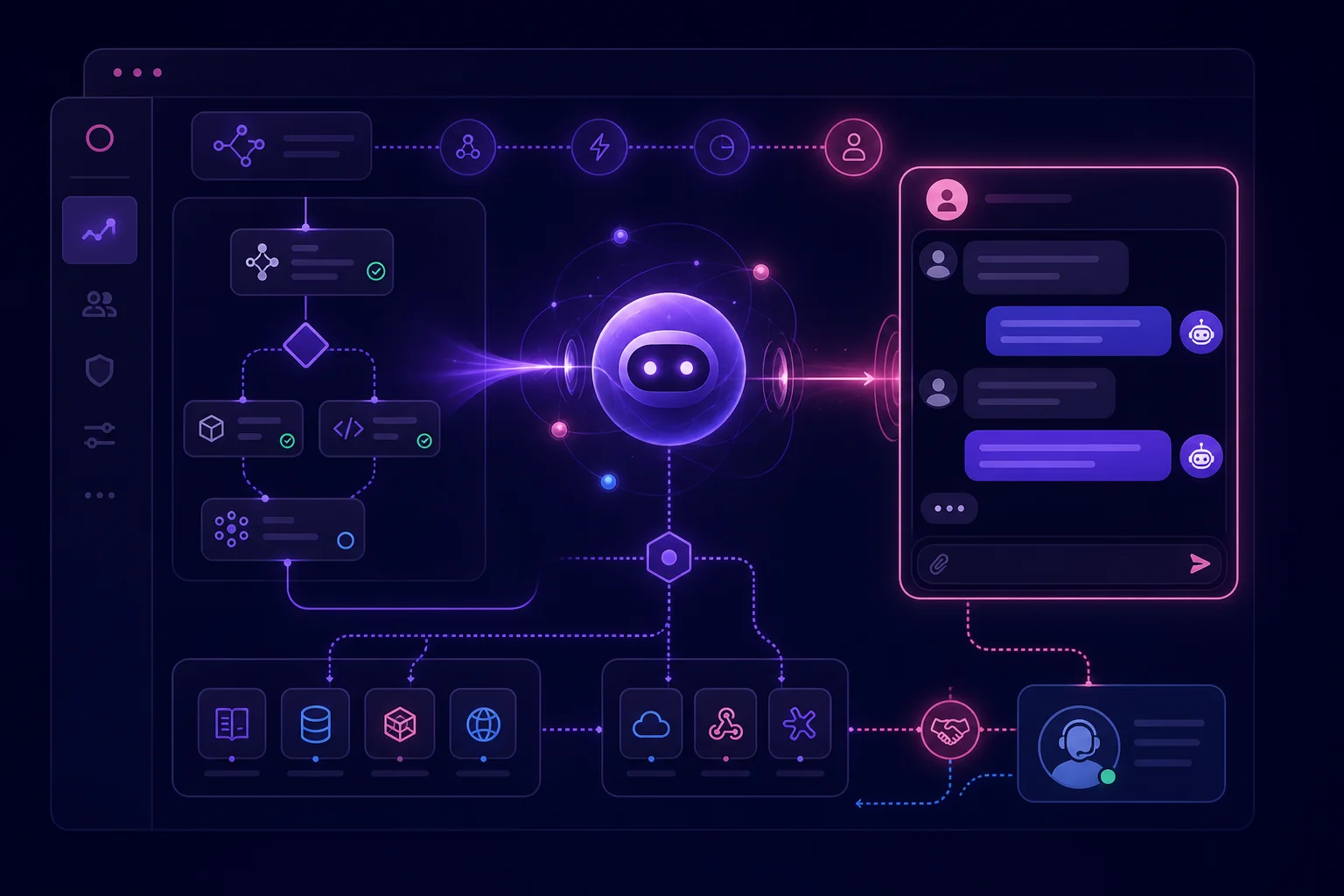
Moving an internal support agent into a customer-facing product changes the risk model. Employees can recognize weak answers, work around missing context, and report failures. Customers should not have to. The available research does not include a primary Snyk source that validates its timeline or implementation, so this article does not claim undocumented details about Snyk. Instead, it breaks down the productization path implied by the case: constrain the workflow, preserve human control, and measure whether the customer’s problem was actually resolved.
Why Snyk’s internal agent needed a productization path
An internal agent is an experiment inside a trusted environment. A customer-facing agent is part of the product.
That distinction affects every layer:
- Who can use the agent
- Which data it can access
- Which tools it can call
- What happens when it is wrong
- Who owns escalated cases
- How the team defines success
Before expanding an employee-facing support experiment, document its original operating conditions. Avoid reconstructing a convenient success story after the fact.
A useful transition record looks like this:
| Question | Evidence to collect |
|---|---|
| What support problem triggered the experiment? | Ticket categories, repeated questions, or workflow bottlenecks |
| Who used the internal agent? | Support engineers, account teams, or product specialists |
| What could it do? | Search documentation, draft replies, classify requests, or call approved tools |
| What justified broader access? | Reviewed conversations, successful workflow completions, and known failure patterns |
| What changed before customer access? | Authentication, permissions, escalation, logging, and evaluation |
| What gates controlled rollout? | Internal replay, employee beta, limited customer cohort, and rollback criteria |
These are not launch milestones attributed to Snyk. They are the milestones you need to validate against a primary source before presenting the Snyk case as history.
The core productization question is not, “Did employees like it?” It is, “Can customers use it safely when the happy path breaks?”
Start with a bounded workflow, not a general-purpose chatbot
A support chatbot automates conversational interactions. It may use AI, machine learning, and natural language processing to understand and answer requests. An AI agent adds a different capability: it can follow a workflow, use connected tools, and perform an approved action.
That difference should shape your scope.
Do not start with “answer any Snyk question.” Define an explicit contract, such as:
supported_intents:
  - explain_documented_product_behavior
  - locate_relevant_documentation
  - collect_diagnostic_context
  - route_issue_to_support

excluded_intents:
  - modify_customer_configuration
  - disclose_account_or_security_data
  - make_contractual_commitments
  - diagnose_unsupported_integrations

knowledge_sources:
  - approved_product_documentation
  - reviewed_support_articles

allowed_channels:
  - authenticated_support_portal

terminal_states:
  - answered_with_sources
  - escalated_to_human
  - blocked_by_policy
  - failed_safely
The terminal_states field matters. An agent needs a valid state for “I cannot complete this request.” Without it, the model is pushed toward generating another plausible answer.
You can enforce the contract before calling the model:
from dataclasses import dataclass
from enum import Enum


class Decision(str, Enum):
    HANDLE = "handle"
    ESCALATE = "escalate"
    BLOCK = "block"


@dataclass
class Request:
    intent: str
    authenticated: bool
    asks_for_human: bool = False


SUPPORTED = {
    "explain_documented_product_behavior",
    "locate_relevant_documentation",
    "collect_diagnostic_context",
    "route_issue_to_support",
}

BLOCKED = {
    "disclose_account_or_security_data",
    "make_contractual_commitments",
}


def route(request: Request) -> Decision:
    if request.asks_for_human:
        return Decision.ESCALATE
    if request.intent in BLOCKED:
        return Decision.BLOCK
    if not request.authenticated:
        return Decision.ESCALATE
    if request.intent not in SUPPORTED:
        return Decision.ESCALATE
    return Decision.HANDLE
This is deliberately simple. The important part is that scope is executable, not buried in a prompt.
Put permissions and failure paths around every customer action
A conversational answer and a customer action carry different risks.
For example, canceling an order and issuing a refund requires identity verification, access to the order, sufficient permissions, an API call, and a defined failure path. The same principle applies to a developer product. Reading public documentation is not equivalent to changing account configuration or accessing private project data.
Use these defaults:
- Authenticate the customer before loading account context.
- Give each tool the minimum required permission.
- Keep tools read-only unless mutation is necessary.
- Require approval for risky or irreversible changes.
- Log the request, selected tool, authorization decision, and result.
- Return a safe failure state when authentication or a tool call fails.
- Make retries idempotent so the same request does not apply twice.
A tool wrapper can enforce those rules outside the model:
def get_project_status(*, user, project_id, api):
    if not user.authenticated:
        raise PermissionError("Authentication required")

    if project_id not in user.allowed_project_ids:
        raise PermissionError("Project access denied")

    try:
        return api.read_project_status(project_id)
    except TimeoutError:
        return {
            "status": "tool_failed",
            "next_action": "escalate",
            "customer_message": "I could not retrieve the project status.",
        }
The model should not decide whether the user is authorized. Your application should.
For a deeper implementation pattern, see production AI agent security with IAM, secrets, and isolation.
Make human supervision an operating model, not a handoff button
A “talk to a person” button is useful. It is not an operating model.
Define escalation triggers before launch:
- The intent is unsupported.
- The customer directly requests a person.
- The agent produces repeated failed answers.
- The request includes sensitive account context.
- Confidence falls below your review threshold.
- A tool returns an error or incomplete result.
- The workflow reaches an approval gate.
Current support systems can also trigger transfers after a configured number of messages or multiple failed responses. Transfer quality itself is an evaluation criterion, alongside setup and multichannel behavior.
Each escalation should include enough context for a support engineer to continue without forcing the customer to repeat the issue:
{
  "reason": "tool_failure",
  "customer_intent": "check_project_status",
  "authenticated": true,
  "actions_attempted": ["read_project_status"],
  "tool_result": "timeout",
  "sources_shown": [],
  "conversation_summary": "Customer cannot confirm the latest project status.",
  "recommended_next_step": "Support engineer checks service status."
}
Assign clear ownership. Decide which team reviews escalated conversations, how quickly it reclaims a case, and who approves changes to the agent’s instructions.
Human corrections should not flow directly into production prompts. Review them first. Convert recurring corrections into one of four controlled changes:
- A knowledge-base update
- A routing-rule update
- A tool or permission change
- A new evaluation case
This turns supervision into a feedback system. The same questions—routing, guardrails, latency, and customer satisfaction—also appear when evaluating customer-experience agents across different sectors.
Measure resolution that customers confirm—not answers or billable outcomes
A generated answer is not a resolved case.
Some support tools bill for a “result” that may represent either a resolution or a transfer triggered by a configured procedure. That billed result does not automatically mean the customer confirmed that the issue was solved.
Track the support funnel as separate events:
request_received
  -> answer_generated
  -> answer_accepted
  -> workflow_completed
  -> customer_confirmed_resolution

Alternative paths:
  -> escalated
  -> abandoned
  -> reopened
  -> marked_incorrect
Do not collapse these states into a single “handled” counter.
Useful metrics include:
- Effective resolution rate: cases completed without reopening and confirmed as resolved
- First-contact resolution: issues resolved during the initial interaction
- Reopen rate: cases reopened after the agent marked them complete
- Escalation rate: cases transferred to a person
- Time to resolution: elapsed time from request to confirmed outcome
- Unsupported-intent rate: requests outside the published scope
- Human-verified accuracy: sampled answers judged against approved evidence
Instrument the states directly:
def record_outcome(events, case_id, outcome):
    allowed = {
        "answer_accepted",
        "workflow_completed",
        "customer_confirmed_resolution",
        "escalated",
        "reopened",
        "marked_incorrect",
    }
    if outcome not in allowed:
        raise ValueError(f"Unknown outcome: {outcome}")

    events.write({
        "case_id": case_id,
        "outcome": outcome,
    })
This gives product and support teams the same vocabulary. It also prevents an impressive answer count from hiding low resolution or high reopen rates.
Turn the customer launch into a continuous evaluation loop
Do not move directly from internal use to unrestricted customer access.
Use staged rollout:
- Replay historical, reviewed support cases.
- Run an employee beta with production-like permissions.
- Open access to a limited customer cohort.
- Define rollback criteria before expanding.
- Review failures and out-of-scope requests every week.
Build a reference dataset from real support patterns. Include normal requests, ambiguous wording, unsupported intents, authentication failures, missing knowledge, tool errors, and direct requests for a human.
Then run the same cases against each candidate release. Store:
- Input and expected route
- Allowed knowledge sources
- Expected tool calls
- Forbidden actions
- Required escalation behavior
- Final resolution state
Repeated trials matter because model behavior can vary. Regression tests should block releases that weaken routing, citations, permissions, or escalation. The reproducible AI agent evaluation guide covers reference datasets, measurable graders, repeated trials, and production feedback loops.
Production conversations should feed the dataset through a controlled review process. Support tooling can already report questions that the connected knowledge base could not answer. It can also let reviewers approve suggested corrections before those changes enter the agent’s instructions.
That pattern closes the loop:
production failure
  -> classify root cause
  -> propose correction
  -> human review
  -> add regression case
  -> test candidate release
  -> deploy or reject
Conclusion
An internal AI customer support agent becomes a product only when its operating assumptions become explicit. You need bounded intents, least-privilege tools, safe failure paths, owned escalation, and outcome-level telemetry.
The three non-negotiables are simple: bounded scope, human control, and verified resolution. Hosting and deployment come after those decisions, but they should preserve them through isolated secrets, observable runs, reproducible releases, and rollback. That is where an agent platform such as HollowHost can support the runtime without replacing the product controls your team still needs to design.