Evaluating Customer Experience AI Agents Across Sectors
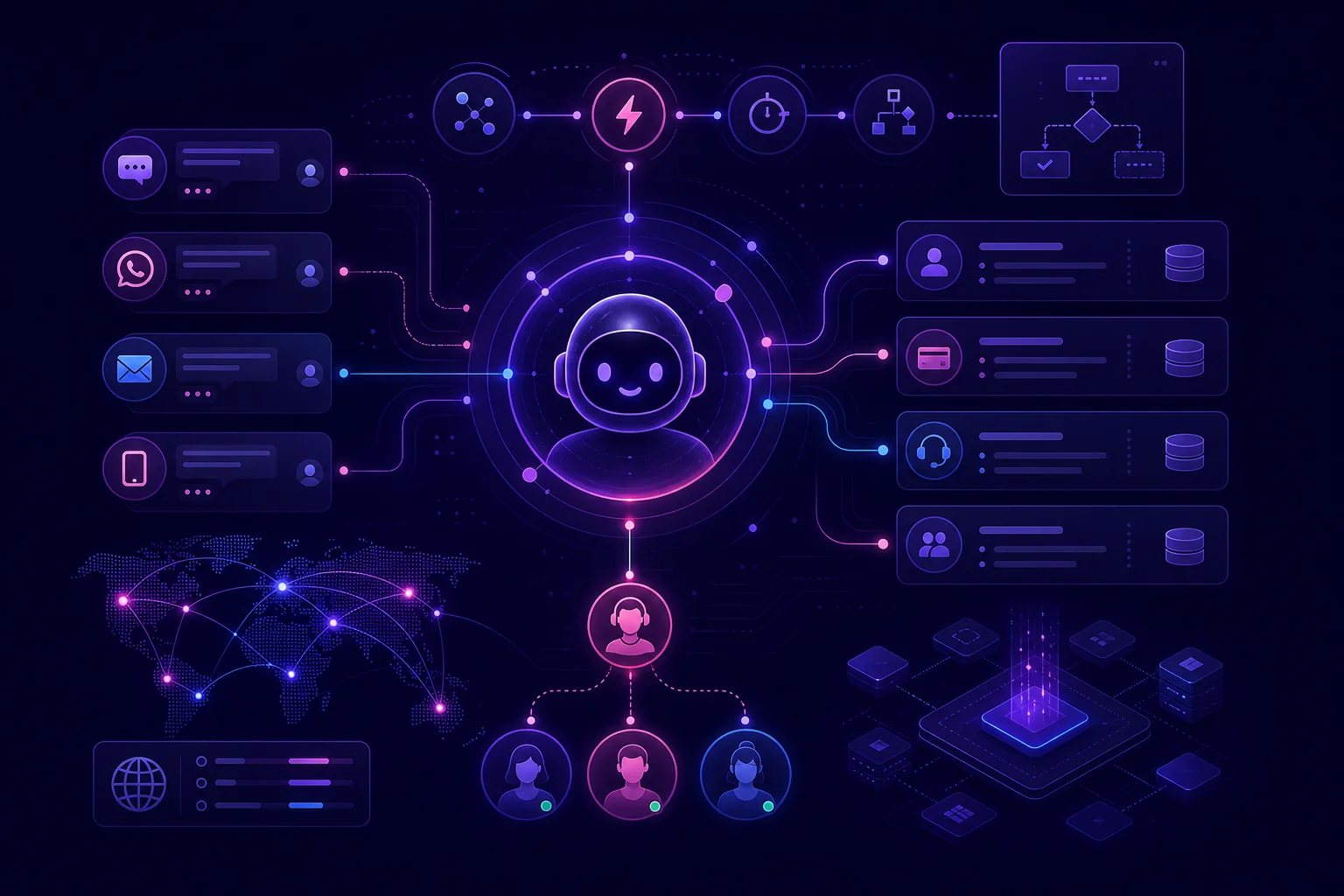
Customer experience AI agents fail when teams optimize the demo instead of the operating model. A fluent answer is not enough. The agent must retrieve current data, call backend systems, escalate cleanly, and remain measurable under load.
The available research does not provide primary deployment results for Lyft, Vodafone, or LATAM Airlines. It therefore cannot support claims about their architectures or outcomes. Instead, this article uses their different operating contexts as a practical framework for evaluating production deployments without inventing case-study details.
What customer experience AI agents must do in production
A customer experience AI agent is more than a chat interface. It must understand a request, determine the required steps, and execute an approved workflow. That could include processing a refund or modifying a policy without human intervention, according to Kore.ai’s definition of customer service agents.
Production agents may need to:
- Accept requests through text or voice.
- Retrieve current customer and operational data.
- Reason over policies and conversation history.
- Call CRM, billing, ticketing, and contact-center systems.
- Execute permitted actions.
- Return a clear result or route the case to a human.
The hard part is not generating the next sentence. It is coordinating state, permissions, tool calls, failures, and handoffs.
Adoption figures also hide an execution gap. An Intercom study cited by Fin surveyed 2,470 support professionals worldwide in the fourth quarter of 2025. Only 10% said they had reached mature deployment, defined as AI fully integrated into support operations and producing measurable results at scale. The same report said 82% of surveyed senior leaders had invested in customer service AI during the previous 12 months, while 87% planned to invest in 2026 (source).
The production question is therefore not whether you can connect an LLM to a help center. It is whether the complete workflow behaves predictably.
Model each request as an explicit state machine:
RECEIVED
  -> CLASSIFIED
  -> CONTEXT_LOADED
  -> ACTION_PROPOSED
  -> ACTION_CONFIRMED
  -> ACTION_EXECUTED
  -> RESOLVED

Any state
  -> ESCALATION_REQUESTED
  -> HUMAN_ASSIGNED
  -> HUMAN_TAKEOVER
  -> RESOLVED
Persist each transition. A transcript alone will not tell you whether the model selected the wrong tool, the billing API timed out, or the user rejected a proposed action.
Three sectors, three deployment constraints: Lyft, Vodafone, and LATAM Airlines
The research dossier does not document the actual Lyft, Vodafone, or LATAM Airlines deployments. Treat the companies as three validation contexts, not as evidence for specific technical choices.
For Lyft, candidate test scenarios include urgent ride, trip, and account issues. For Vodafone, validate high-volume account and network-support workflows. For LATAM Airlines, test disruption-sensitive booking, baggage, and rebooking workflows. These are areas to verify against primary case sources before attributing them to any deployed agent.
The useful comparison is operational:
| Context | Questions to validate |
|---|---|
| Ride-hailing | Does urgency change queue priority? Which trip or account actions require immediate human review? What happens if live trip data is unavailable? |
| Telecommunications | Can the agent distinguish an informational answer from an account change? How does it handle repeated diagnostics? Which billing or identity operations require confirmation? |
| Airline | Can the workflow preserve booking context across channels? How are disruption-related requests prioritized? Which booking, baggage, or rebooking actions remain human-controlled? |
Apply the same five-part review to each context.
Risk: List every action the agent can propose and execute. Separate read-only retrieval from reversible changes and irreversible changes.
Channel mix: Test each supported channel independently. Voice introduces different turn-taking and handoff behavior than asynchronous email.
Backend integrations: Document the source of truth for every field. A generated answer must not substitute for current account, trip, booking, billing, or ticket data.
Language needs: Evaluate retrieval, policy interpretation, tool arguments, and escalation summaries in every supported language. A multilingual response layer is not enough if the backend action is mapped incorrectly.
Automation scope: Start with narrow intents. Expand only when evaluation data shows that the agent can resolve them safely. For implementation patterns, see this production guide to human handoff and AI agent routing.
Human handoff is a product workflow, not a fallback button
A handoff must have defined triggers, payloads, queue semantics, and ownership. “Talk to a person” cannot be an unstructured escape hatch.
Useful escalation triggers include:
- Low classification or retrieval confidence.
- Repeated unsuccessful turns.
- An explicit customer request.
- A sensitive account change.
- A safety or policy exception.
- Payment or refund risk.
- Missing, inconsistent, or stale backend data.
- A tool timeout after the approved retry policy.
- An action outside the agent’s permission set.
Decide whether each escalation is synchronous or asynchronous. A live voice or chat request may need an available-agent queue. An email case may enter an asynchronous ticket queue. In both cases, transmit the conversation, detected intent, retrieved records, attempted tool calls, errors, and proposed next action.
Fin’s evaluation criteria emphasize that transfer quality depends on both the supported channels and the context passed during escalation (source).
Implement a clear takeover state. Once a human accepts the case, the AI agent should not continue issuing customer-visible replies or backend mutations unless the human explicitly returns control.
A minimal routing function can remain deterministic:
from dataclasses import dataclass
from enum import Enum


class Route(str, Enum):
    AUTOMATE = "automate"
    CONFIRM = "confirm"
    HUMAN = "human"


@dataclass(frozen=True)
class Case:
    confidence: float
    failed_turns: int
    customer_requested_human: bool
    sensitive_action: bool
    irreversible_action: bool
    tool_available: bool


def choose_route(case: Case) -> Route:
    if (
        case.customer_requested_human
        or case.failed_turns >= 2
        or not case.tool_available
        or case.confidence < 0.75
    ):
        return Route.HUMAN

    if case.sensitive_action or case.irreversible_action:
        return Route.CONFIRM

    return Route.AUTOMATE


if __name__ == "__main__":
    example = Case(
        confidence=0.91,
        failed_turns=0,
        customer_requested_human=False,
        sensitive_action=True,
        irreversible_action=False,
        tool_available=True,
    )
    print(choose_route(example).value)
The thresholds above are illustrative configuration values, not benchmarks from the named deployments. Tune them using your own labeled conversations and incident data.
Guardrails that separate useful automation from unsafe automation
Guardrails should constrain both language and action.
Start with least privilege. Give each tool only the permissions required for its workflow. A knowledge-retrieval tool should not inherit refund permissions. An account-verification workflow should not gain access to unrelated customer records.
Then add controls at the action boundary:
- Maintain an allowlist of approved tools and operations.
- Validate tool arguments against a strict schema.
- Require confirmation before sensitive or irreversible changes.
- Ground policy answers in approved sources.
- Limit access to personally identifiable information.
- Apply rate limits per user, workflow, and backend.
- Record prompts, retrieval references, tool calls, results, and state transitions.
- Require human approval for defined risk classes.
- Provide rollback procedures where the backend supports reversal.
- Add a kill switch that disables mutations without taking down read-only support.
Kore.ai identifies auditability, guardrails, and observability as important enterprise governance capabilities (source). Fin similarly includes permissions, auditability, testing, supervision, quality assurance, and escalation controls in its reliability criteria.
Do not log everything blindly. Define which fields are necessary for debugging, which must be redacted, and how operators correlate a customer-facing error with a tool execution.
For a concrete Python implementation, use the AI agent observability guide for logging, tracing, and monitoring.
Latency in production: set budgets by channel and task
The research provides no measured latency values for the three named deployments. Do not fill that gap with assumed benchmarks. Capture values from primary evidence or your own telemetry.
Break end-to-end latency into components:
total latency =
    request validation
  + intent classification
  + context retrieval
  + model reasoning
  + backend tool calls
  + response generation or streaming
  + handoff routing
Record each component separately. A slow reply could come from retrieval, the model, a CRM call, or queue assignment. Total duration alone cannot identify the bottleneck.
Track at least:
- Median latency, commonly labeled p50.
- Tail latency, such as p95.
- Tool timeout count.
- Retry count and added delay.
- Time from escalation request to human takeover.
- Customer abandonment during processing.
Set budgets by workflow. An informational answer and a transactional change should not share the same timeout policy. The transactional flow may require retrieval, verification, confirmation, and a backend write.
Retries also need boundaries. Retry transient backend errors only when the operation is idempotent, meaning repeating it cannot create a second unintended change. Otherwise, query the transaction state before trying again.
Analyze latency with quality signals. Faster is not automatically better if shorter reasoning increases escalation or repeat contacts. Slower is not automatically safer if customers abandon the interaction before resolution.
Measure satisfaction without confusing deflection with resolution
Deflection measures whether a ticket was avoided. Resolution measures whether the customer’s problem was actually solved. Fin explicitly distinguishes the two: lower ticket volume is insufficient if the agent cannot handle multi-turn issues, retrieve the right information, and complete the request (source).
Build a scorecard that joins conversation, tool, handoff, and outcome data:
| Metric | What it should reveal |
|---|---|
| True resolution rate | Whether the requested outcome was completed |
| CSAT after automation | Satisfaction with AI-only cases |
| CSAT after transfer | Satisfaction when a human took over |
| Customer effort | How difficult the interaction felt |
| First-contact resolution | Whether another contact was needed |
| Repeat contacts | Whether apparent resolutions generated follow-up |
| Reopen rate | Whether closed cases returned |
| Escalation rate | How often automation required a human |
| Containment | How often the interaction stayed within automation |
| End-to-end latency | How long the customer waited |
| Tool failure rate | How often backend execution failed |
| Cost per resolved case | Cost tied to outcomes rather than conversations |
Use segmented results. Break them down by intent, channel, language, action type, model version, tool version, and whether a human took over. An aggregate score can hide a failing refund flow behind a large volume of easy informational requests.
Fin’s broader evaluation criteria include resolution quality, action execution, safety, handoff, integrations, scalability, and total cost of ownership. Your release gate should reflect the same system-level view.
Roll out in phases:
- Run offline evaluation against labeled cases.
- Shadow live traffic without customer-visible actions.
- Pilot a narrow set of low-risk intents.
- Expand with guarded permissions.
- Monitor regressions by workflow.
- Review incidents and failed handoffs.
- Roll back models, prompts, tools, or permissions when a release degrades outcomes.
The reproducible AI agent evaluation guide shows how to build reference datasets, measurable graders, repeated trials, and regression tests.
Conclusion
Lyft, Vodafone, and LATAM Airlines represent different operating constraints, but the production questions stay consistent. Can the agent retrieve current data, execute approved actions, transfer complete context, respect permission boundaries, and produce measurable resolutions?
Do not claim deployment lessons without primary evidence. Record real latency and satisfaction values. Separate containment from resolution. Treat human handoff as a first-class workflow. Make every action observable and reversible where possible.
Once those controls exist, the hosting layer becomes easier to evaluate. You need isolated secrets, reliable execution, structured logs, and deployments you can roll back. Follow this serverless AI agent deployment guide to turn those requirements into a concrete release workflow. A managed agent runtime such as HollowHost can support that operational foundation while your team keeps control of the customer workflow and its release gates.