Scaling AI Agents: Enterprise Bottlenecks Explained
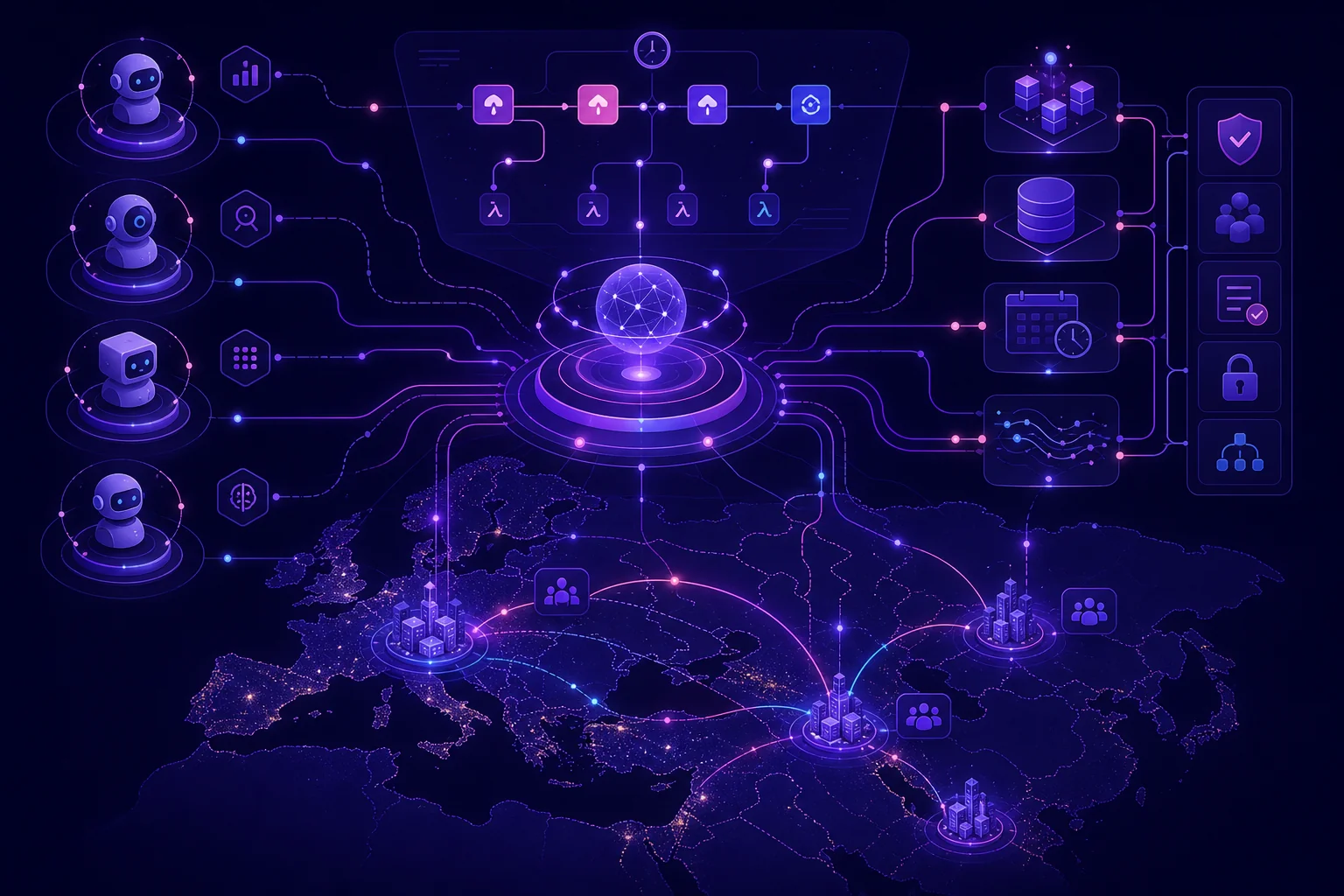
Scaling AI agents is not mainly about running more model calls. It is about controlling a growing graph of queues, tools, data, retries, and human decisions. A pilot can hide weak ownership and fragile state management. An enterprise deployment cannot. For teams operating across Europe and the Middle East, you must also decide where data flows, when humans approve actions, which languages you support, and who responds outside regional working hours. This guide turns those concerns into an operational plan.
1. What Changes When Scaling AI Agents Beyond a Pilot
A pilot often has one codebase, one owner, and one data source. Failures are reviewed manually. Costs are visible on a single provider invoice. Deployment may be little more than a scheduled Python script.
An agent estate changes the unit of operation. You are no longer operating isolated scripts. You are operating workflows with dependencies.
IBM reports that 76% of surveyed executives already operate or provide proofs of concept for autonomous intelligent workflow automation. It also reports that 86% expect process automation and workflow reinvention to be more effective with AI agents by 2027. Moving those proofs of concept into production requires more than increasing compute capacity.
Each workflow needs:
- A business and technical owner.
- An explicit trigger, such as cron, webhook, or queue event.
- Defined inputs, outputs, and allowed tools.
- A service-level objective, or SLO, for reliability and latency.
- A recovery path for partial execution.
- A human approval or escalation policy.
- A cost allocation key.
- A versioned deployment and rollback procedure.
Regional deployment adds design questions. Do not treat “Europe and the Middle East” as one infrastructure profile. Record which systems contain sensitive data, where each integration is hosted, and whether outputs can cross operational boundaries. Define language evaluation datasets separately. Assign incident coverage based on regional operating hours.
Start with an inventory rather than an architecture diagram:
workflow: supplier-review
owner: procurement-platform
trigger: queue
risk_tier: approval-required
inputs:
  - supplier_record
tools:
  - approved-document-store
  - internal-risk-api
output: review_recommendation
human_approval: required
state: persistent
This record becomes the basis for deployment, permissions, monitoring, and cost reporting.
2. Orchestration Is the First Bottleneck: Match Architecture to the Workflow
Adding agents does not guarantee better results. Google evaluated 180 configurations across five architectures: single-agent, independent, centralized, decentralized, and hybrid. The evaluation used Finance-Agent, BrowseComp-Plus, PlanCraft, and Workbench.
The results show why architecture must follow workflow shape. Adding agents produced an 81% relative improvement on Finance-Agent. On PlanCraft, described as sequential, performance fell by 70%. Google’s predictive model selected the optimal architecture for 87% of unseen tasks in the evaluation.
Use these patterns deliberately:
| Architecture | Best workflow shape | Latency | Throughput | Fault handling | Ownership | Operational complexity |
|---|---|---|---|---|---|---|
| Single-agent | Sequential work with shared context | Accumulates across steps | Limited by one worker | Simple recovery boundary | Clear | Low |
| Independent | Parallel, self-contained tasks | Driven by the slowest branch | High potential | Failures remain local | Distributed | Medium |
| Centralized | Parallel specialists needing synthesis | Adds orchestration overhead | Controlled centrally | Orchestrator can retry or reroute | Clear central owner | Medium |
| Decentralized | Agents collaborating without one controller | Variable | Depends on coordination | Harder to reconstruct | Shared | High |
| Hybrid | Mixed sequential and parallel stages | Depends on graph design | Flexible | Requires per-stage policies | Must be explicit | High |
An independent design maximizes parallelism with minimal coordination. It fits competitor monitoring where separate workers inspect approved sources and return evidence-backed changes.
A centralized design uses an orchestrator to delegate work and synthesize results. It fits lead enrichment when specialist agents validate company data, classify records, and prepare one CRM update.
Keep sequential work sequential. If a reporting agent must fetch data, validate it, calculate a summary, and request approval in order, turning every step into a communicating agent adds coordination without creating useful parallelism.
Draw the dependency graph before selecting a framework:
event
  |
validate input
  |
+-------------------+
|                   |
fetch approved API  fetch internal records
|                   |
+---------+---------+
          |
      synthesize
          |
    human approval
          |
       publish
The two fetch operations can run independently. Validation, synthesis, approval, and publication remain ordered.
3. Queues, Concurrency, and Recovery: Prevent Agent Cascades
A queue separates event intake from execution. It also creates new failure modes. If downstream services slow down while producers continue accepting work, queue wait time rises. If every agent retries independently, one provider failure can produce a cascade of duplicate requests.
Use these controls:
- Partition queues by tenant and priority. A large batch from one business unit should not block urgent work from another.
- Bound concurrency. Treat model providers, internal APIs, and databases as separate constrained resources.
- Apply backpressure. Stop or slow producers when queue age or dependency errors exceed your operating threshold.
- Set one retry owner. Either the orchestrator retries a stage or the worker does. Avoid both.
- Add jitter. Randomized retry delay prevents workers from retrying simultaneously.
- Use a dead-letter queue. Move exhausted tasks aside for inspection rather than blocking healthy work.
- Make writes idempotent. Reprocessing the same event must not create duplicate CRM records, reports, or notifications.
- Persist checkpoints. Resume from the last completed stage instead of repeating the full workflow.
- Enforce a timeout budget. Each stage receives only part of the workflow’s total allowed time.
- Open circuit breakers. Pause calls to a failing dependency instead of feeding it more traffic.
A minimal idempotent worker can use a stable event key:
import sqlite3
from contextlib import closing

def process(event_id: str, payload: str) -> str:
    with closing(sqlite3.connect("agent.db")) as db:
        db.execute(
            "CREATE TABLE IF NOT EXISTS runs "
            "(event_id TEXT PRIMARY KEY, result TEXT NOT NULL)"
        )

        row = db.execute(
            "SELECT result FROM runs WHERE event_id = ?", (event_id,)
        ).fetchone()

        if row:
            return row[0]

        result = payload.strip().upper()  # Replace with your bounded agent step.

        db.execute(
            "INSERT INTO runs(event_id, result) VALUES (?, ?)",
            (event_id, result),
        )
        db.commit()
        return result

if __name__ == "__main__":
    print(process("supplier:example:review", "manual approval required"))
For webhook ingestion, validation, deduplication, and resilient workers, see the event-driven AI agent implementation guide. For executions that exceed one runtime window, use persistent checkpoints and resumable task design.
4. Observability and Evaluation: Measure the Whole Agent Graph
Google defines an agentic task through three properties: sustained multi-step interaction with an external environment, iterative information gathering under partial observability, and strategy adaptation based on environmental feedback.
That means a final HTTP status is not enough. You need to reconstruct the path that produced the output.
Track operational telemetry at both workflow and agent level:
- End-to-end latency.
- Queue wait time.
- Latency by stage and tool.
- Model tokens and tool calls.
- Failure and retry rates.
- Human escalation rate.
- SLO breaches.
- Cost per successful workflow.
- Workflow, prompt, model, tool, and schema versions.
Use a shared trace identifier across the graph:
import json
import logging
import time
import uuid

logging.basicConfig(level=logging.INFO, format="%(message)s")

def run_stage(stage: str, trace_id: str) -> None:
    started = time.monotonic()
    status = "ok"

    try:
        # Execute one agent or tool step here.
        pass
    except Exception:
        status = "error"
        raise
    finally:
        logging.info(json.dumps({
            "trace_id": trace_id,
            "stage": stage,
            "status": status,
            "latency_ms": round((time.monotonic() - started) * 1000),
        }))

run_stage("validate_input", str(uuid.uuid4()))
Telemetry tells you whether the system ran. Evaluation tells you whether it produced acceptable work. Keep these systems connected but separate.
Run reproducible quality checks against a fixed dataset. Store expected evidence, allowed tool behavior, and grading criteria. Repeat evaluations when prompts, models, tools, or schemas change. Compare quality alongside latency and cost rather than promoting a version based on one dimension.
The Python agent observability guide covers structured logs and traces. The reproducible agent evaluation guide shows how to build reference datasets and regression tests.
5. Cost and Isolation: Control the Blast Radius of a Growing Agent Fleet
A provider invoice cannot tell you which workflow is useful. Attribute spend to the execution that generated it.
Record cost dimensions by:
- Workflow and agent.
- Tenant or business unit.
- Model and token usage.
- Tool and API calls.
- Runtime and storage.
- Retries and failed runs.
- Human intervention.
- Successful final output.
Separate variable inference and API spend from platform costs such as storage, queues, logging, and deployment. Keep engineering and on-call work visible as operating costs. Then optimize cost per successful workflow, not cost per model call. The production AI agent cost analysis provides a broader framework for comparing runtime models.
Isolation limits both accidental data access and the effect of a compromised agent. Give each deployed agent an identity. Grant only the tools, secrets, storage paths, and network destinations required by its workflow.
At minimum:
- Separate development, evaluation, and production environments.
- Scope secrets to an agent and environment.
- Restrict network egress to approved services.
- Partition tenant data and persistent context.
- Validate tool arguments before execution.
- Treat agent output as untrusted input to the next stage.
- Revoke an agent identity without disabling the whole fleet.
- Preserve an audit trail for approvals and external actions.
IBM identifies multi-agent orchestration, event-driven integration, centralized agent catalogs with lifecycle management, agent memory, long-term context stores, modular data products, governance, observability, and security as necessary architecture capabilities. Treat the catalog as an operational control plane. It should answer what is deployed, who owns it, which version runs, what it can access, and how to stop it.
6. A Practical Migration Plan: From 3 Agents to a Governed Production Estate
Use stage gates. Do not migrate every prototype at once.
Inventory and classify
- List each workflow, trigger, tool, data source, and owner.
- Mark stages as sequential or parallel.
- Assign a risk tier and human approval policy.
- Document regional data, language, and support requirements.
Build the execution foundation
- Define SLOs and timeout budgets.
- Establish queue partitions, quotas, and concurrency policies.
- Add idempotency keys and persistent checkpoints.
- Define retry ownership, rollback, and dead-letter handling.
Instrument and evaluate
- Trace the entire workflow.
- Capture per-stage latency, retries, token use, and cost.
- Evaluate against a fixed reference dataset.
- Version prompts, tools, models, schemas, and deployment artifacts.
Run a bounded pilot
- Start with one tenant or business unit.
- Limit permissions and external actions.
- Require approval for consequential writes.
- Test dependency failures and interrupted runs.
Apply go/no-go criteria
Promote only when the workflow meets your defined limits for error rate, output quality, cost per successful run, queue saturation, recovery time, and security review. Averages are not enough. Inspect failed and escalated workflows directly.
Expand by risk tier
Move low-impact reporting and monitoring workflows first. Keep stronger approval and isolation boundaries around workflows that modify enterprise systems. Assign regional responsibility for data decisions, support coverage, and incident response instead of assuming one global deployment pattern will fit every team.
Conclusion
Scaling AI agents is an operations problem before it is a model problem. Match orchestration to the workflow. Bound queues and retries. Persist state. Measure the whole graph. Attribute cost to successful outcomes. Isolate every agent by identity, tenant, and environment.
A deployment platform can remove part of the undifferentiated work around builds, schedules, secrets, and isolated execution. It cannot choose your ownership model or risk boundaries. Make those explicit first. Then use tooling such as HollowHost to implement and operate them consistently.