AI Agent Frameworks: Claw vs Harness Architectures
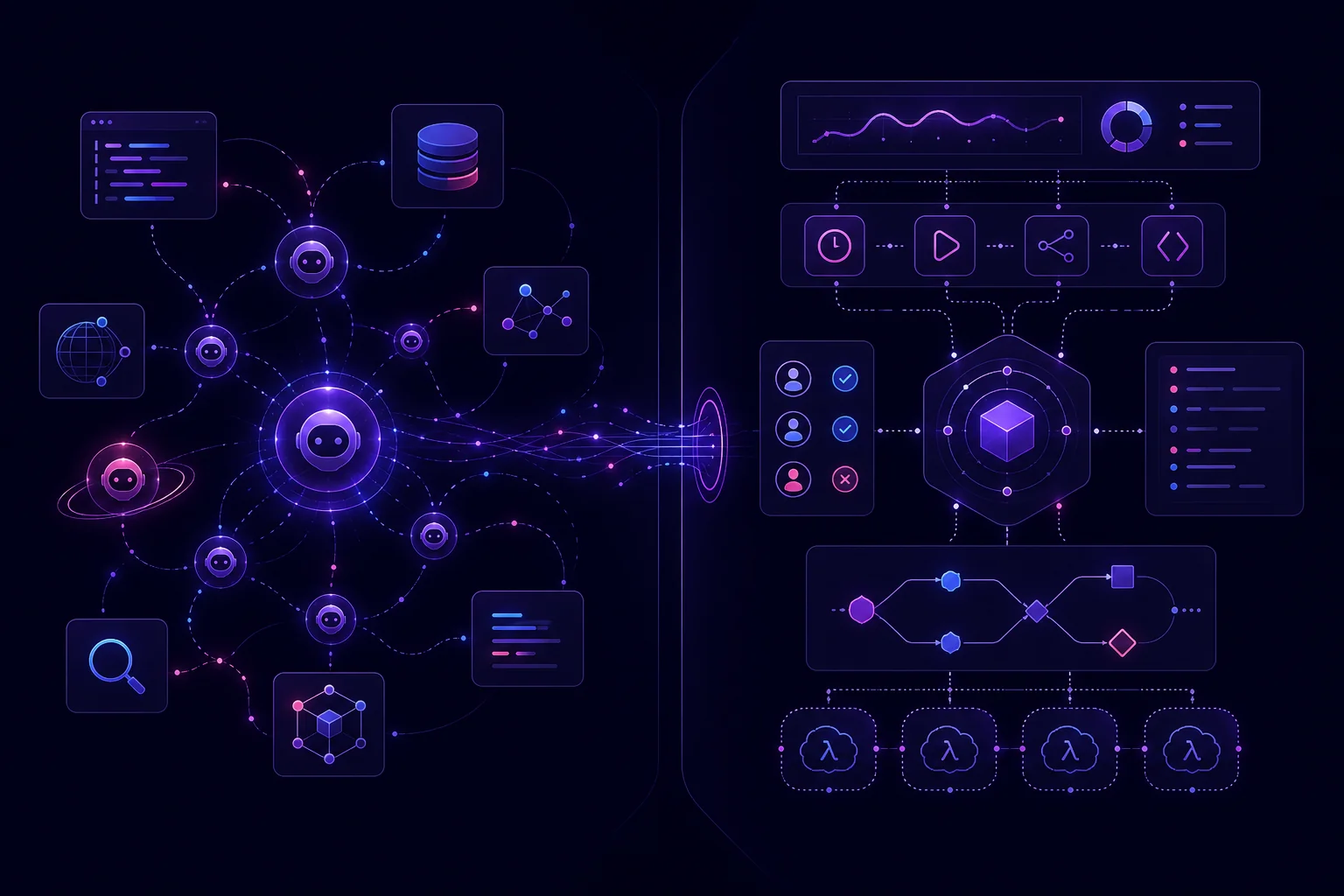
Choosing an AI agent framework is no longer just an SDK decision. The harder question is who controls execution: the agent or the runtime around it. A “claw” architecture gives a persistent agent broad autonomy. A harness constrains that agent with explicit state, permissions, checkpoints, and approvals. Neither pattern is universally better. Compare them across five operational criteria before committing your production architecture.
1. AI Agent Frameworks Are Shifting From Libraries to Runtime Architectures
IBM describes AI agent frameworks as software building blocks for developing, deploying, and managing agents. They may provide predefined architectures, communication protocols, task management, function-call integrations, and supervision tools.
That definition extends beyond application code. A production framework influences:
- Where state lives.
- Which tools the model can call.
- How long an execution loop can run.
- When a human must intervene.
- How the process is deployed and recovered.
For this comparison, claw is a prospective architectural term, not an established framework category. It describes an autonomy-first runtime built around one persistent agent loop. The agent owns its working context and can select from broad tools such as APIs, files, or isolated shell commands.
A harness is the controlled runtime around an agent. It brokers state, tools, execution, approvals, and telemetry. Microsoft uses the term more specifically: its Agent Framework Harness is an opinionated agent for long-running, multi-step tasks. It includes planning, task tracking, context compression, file and memory access, tool approval, and observability.
The useful distinction is therefore about control:
Claw:   task -> autonomous agent loop -> tools -> result
Harness: task -> runtime policy -> bounded agent -> approved tools -> result
This is not another LangGraph-versus-CrewAI roundup. It is a way to decide what your runtime must control regardless of the framework you use.
2. Criterion One — State: Persistent Claw Context vs Harness-Controlled Checkpoints
A claw treats memory, task history, and workspace files as part of the agent’s persistent environment. That supports open-ended work. For example, a competitive-monitoring agent can retain previous findings and use them during its next run. IBM notes that agents can store learned information in memory for future performance.
The tradeoff is implicit state. A process failure can make it difficult to identify completed sources, replay only the failed step, or transfer the task safely to another worker.
A harness models those concerns separately from the model context. Microsoft Agent Framework provides agent sessions for state management and context providers for memory. Its graph-oriented workflows also support checkpointing.
A minimal resumable record can stay framework-neutral:
from dataclasses import asdict, dataclass
import json
from pathlib import Path


@dataclass
class JobState:
    job_id: str
    step: str
    attempts: int
    completed_items: list[str]


def save_state(state: JobState, path: str = "job-state.json") -> None:
    Path(path).write_text(json.dumps(asdict(state), indent=2))


state = JobState(
    job_id="monitoring-run",
    step="collect_sources",
    attempts=0,
    completed_items=[],
)
save_state(state)
For production, the storage backend must survive the compute process. The important design decision is the record itself: job identity, current step, attempts, completed work, and recoverable outputs. See the guide to minimal persistent state for serverless jobs for idempotency and recovery patterns.
Use this table to decide how much state control the runtime needs:
| State requirement | Claw-style state is sufficient when… | Harness-controlled state is preferable when… |
|---|---|---|
| Progress | Model context and workspace history are enough | Progress must exist independently from model context |
| Recovery | Restarting the task is acceptable | A failed step must resume without repeating completed work |
| Concurrency | One agent owns the workspace | Multiple workers or agents must update shared state safely |
| Traceability | The final artifact is the primary record | Operators must reconstruct how a result was produced |
| Context growth | Long-lived context remains manageable | Old context must be summarized, archived, or bounded |
Choose claw-style state when persistent interaction matters more than exact replay. Prefer harness-controlled checkpoints when recovery and auditability are part of correctness.
3. Criterion Two — Tools: Open-Ended Capability in a Claw vs Governed Access in a Harness
IBM identifies APIs, data sources, web search, and other agents as possible external tools. A claw can expose those capabilities directly. It may discover tools dynamically or operate against a persistent filesystem.
That flexibility is useful for ambiguous research. It also makes permissions harder to reason about. A monitoring task that only needs to read approved feeds should not inherit credentials for modifying production systems.
A harness inserts a broker between the model and the capability:
TOOLS = {
    "read_feed": {"handler": lambda url: {"url": url}, "requires_approval": False},
    "publish_report": {"handler": lambda path: {"published": path}, "requires_approval": True},
}


def call_tool(name: str, arguments: dict, approved: bool = False):
    spec = TOOLS[name]

    if spec["requires_approval"] and not approved:
        raise PermissionError(f"{name} requires approval")

    return spec["handler"](**arguments)
This small registry establishes a contract. A production implementation can add argument schemas, per-task credentials, rate limits, middleware, and revocation.
Microsoft Agent Framework supports tool calls, MCP clients, middleware that can intercept agent actions, and tool approvals. MCP, or Model Context Protocol, provides a standardized interface through which compatible applications can expose tools and data to agents.
Check whether your tool layer provides:
- Explicit input and output contracts.
- Credentials scoped to the current task.
- An audit record for requested and executed actions.
- Approval before sensitive operations.
- A way to disable a tool without changing the prompt.
Broad access should not mean ambient access. The production agent security guide covers secrets injection, IAM isolation, and least privilege.
4. Criterion Three — Execution Loops: Autonomous Iteration vs Explicit Workflow Control
The basic claw loop is simple:
Its stopping condition may depend on the model deciding that the task is complete. This fits open-ended work such as researching approved sources and drafting a summary.
A harness turns stopping conditions into enforceable runtime policy:
from time import monotonic


def run_agent(step, max_iterations=8, time_budget_seconds=45):
    started = monotonic()

    for iteration in range(max_iterations):
        if monotonic() - started >= time_budget_seconds:
            return {"status": "checkpoint", "step": step, "iteration": iteration}

        outcome = step()

        if outcome["status"] in {"complete", "needs_approval"}:
            return outcome

    return {"status": "iteration_limit"}
Unlike prompt instructions, iteration and time limits remain effective even when the model continues reasoning. The runtime can then return a defined status instead of depending on an abrupt process termination.
Microsoft recommends an agent for open-ended or conversational tasks requiring autonomous tool use and planning. It recommends a workflow when the steps are well defined or execution order requires explicit control. Its workflows use graphs to connect agents and functions, with typed routing, checkpointing, and human-in-the-loop support.
A practical hybrid assigns different kinds of work to different components:
- A workflow fetches approved source records.
- An agent analyzes each record.
- A deterministic function validates and records each result.
- A review transition handles consequential output.
- A final function publishes the report.
If your runtime imposes hard execution limits, design the job to yield before termination. The guide to resumable AI agent tasks under Lambda timeouts shows how to combine time budgets, retries, and checkpoints.
5. Criterion Four — Supervision: Trusting the Claw’s Autonomy vs Harness Approval and Evidence
Claw supervision often happens around the loop. Operators collect logs, receive alerts, and review the result after execution. Human intervention is primarily an escalation path.
Harness supervision happens at selected control points inside the loop. Middleware can intercept an action, policy can reject it, and a typed transition can route the task to review. The agent can pause before a consequential tool call instead of relying on retrospective inspection.
IBM recommends mapping interactions between agents and identifying stages where human intervention remains necessary. Microsoft’s Harness includes tool approval and observability, while its workflows support human-in-the-loop checkpoints.
For every consequential action, record evidence:
import json
import logging

logging.basicConfig(level=logging.INFO)


def audit(event: str, **fields) -> None:
    logging.info(json.dumps({"event": event, **fields}))


audit(
    "tool_request",
    job_id="monitoring-run",
    tool="publish_report",
    decision="approval_required",
)
Define supervision behavior with an explicit decision table:
| Control point | Evidence or runtime decision required |
|---|---|
| Approval identity | Record who or which policy approved the action |
| Approved scope | Preserve the exact tool name and arguments reviewed |
| Execution integrity | Compare the executed call with the approved proposal |
| Insufficient permission or confidence | Reject, request review, or choose a read-only fallback |
| Operator intervention | Support resume, cancellation, and authorized replay |
Logs and controls serve different purposes. Logs explain what happened; approval gates and middleware can prevent an action before it happens. The Python agent observability guide covers structured logging, tracing, and monitoring.
6. Criterion Five — Deployment: Flexible Claw Runtimes vs Operationally Packaged Harnesses
A claw can run as a persistent daemon, a scheduled job, or an isolated worker. Choose the process model according to the interaction pattern:
- Use a daemon when the agent must retain an active process or respond continuously.
- Use a scheduled job for periodic monitoring, enrichment, or reports.
- Use an event-driven worker when a webhook or queue starts each task.
A harness packages cross-cutting controls as runtime services rather than leaving them as conventions inside application code. This can make execution behavior more consistent across workers, environments, and agent implementations, but it also adds infrastructure that must be operated and versioned.
IBM recommends evaluating deployment according to the environment, including cloud or on-premises operation, and the intended scale. That evaluation should also cover isolation, portability, latency needs, execution cost, and recovery from interrupted work.
Do not place an agent that assumes a durable local workspace into short-lived compute without adapting its storage model. Conversely, do not operate an always-on harness when a bounded scheduled execution satisfies the workload.
The cron-versus-daemon runtime comparison provides a practical way to assess state, speed, cost, and scaling. Whatever runtime you choose, keep secrets outside the repository and isolate each agent’s permissions.
7. Decision Framework: When AI Agent Frameworks Should Adopt Claw, Harness, or a Hybrid
Use the five criteria as an architecture matrix:
| Criterion | Choose claw when… | Choose harness when… |
|---|---|---|
| State | Persistent interaction and flexible memory dominate | Checkpoints, replay, and recovery are required |
| Tools | Discovery and broad composition are central | Access must be scoped, approved, and auditable |
| Execution | The path is ambiguous | Order, retries, and limits must be explicit |
| Supervision | Escalation and post-run review are sufficient | Actions require interception or approval |
| Deployment | A dedicated runtime fits the workload | Lifecycle controls must be packaged consistently |
Choose a hybrid when you need autonomous reasoning without autonomous infrastructure control. Let the claw reason inside a harness that owns credentials, budgets, checkpoints, approvals, and deployment.
To migrate from a conventional framework:
- Externalize task state.
- Define typed tool contracts and permissions.
- Add iteration and time budgets.
- Checkpoint completed work.
- Instrument tool calls and state transitions.
- Add approval gates where effects become consequential.
- Test recovery and deployment isolation.
IBM’s broader selection criteria remain useful: case complexity, data security, ease of use, stack integration, performance, and scalability. The right AI agent framework is not the one with the longest feature list. It is the one whose runtime boundaries match your workload.
For scheduled and event-driven agents, keep reasoning responsibilities separate from execution-layer responsibilities. The framework can handle planning and tool selection, while the runtime handles scheduling, secret delivery, isolation, telemetry, and process lifecycle. Validate that boundary with failure-recovery, permission, and replay tests before production deployment.