Data Pipeline Automation with Render Workflows
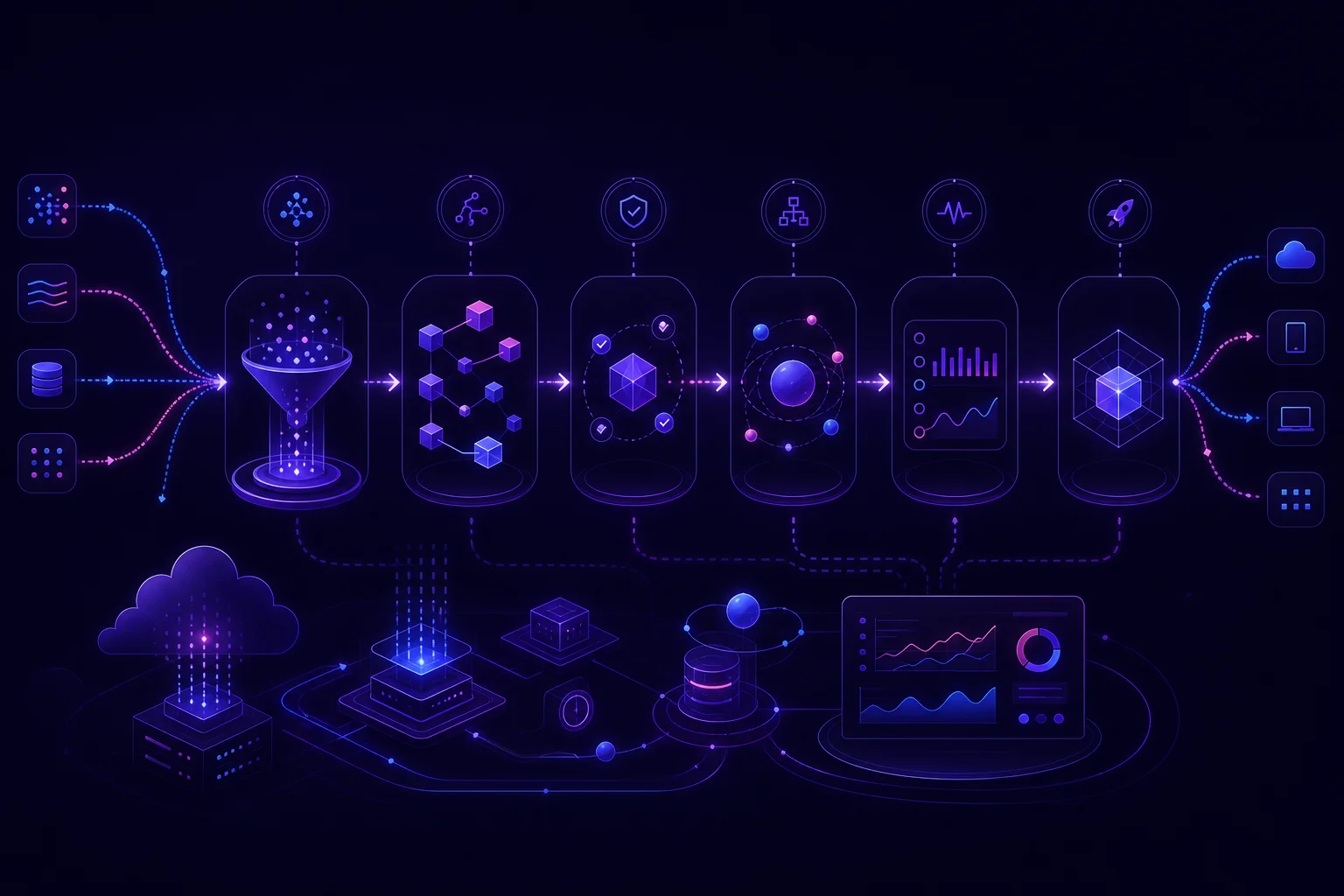
A data pipeline rarely fails cleanly. An API times out after extraction. A schema changes before transformation. A warehouse write succeeds, but the workflow loses its response. Restarting everything can duplicate records or publish partial data.
The fix is not another cron script. You need durable orchestration around small, resumable stages. This guide presents a concrete reference architecture for an internal data pipeline using Render Workflows as the orchestrator. It covers triggers, checkpoints, retries, idempotency, quality gates, and operations without assuming that the orchestrator owns your data.
1. What Data Pipeline Automation Should Solve
Data pipeline automation uses software to orchestrate and manage data movement, transformation, and delivery with minimal human intervention. The goal is not just to schedule a script. It is to make the full execution path predictable.
That matters because maintenance dominates pipeline work. IBM reports that data teams spend 53% of their engineering time maintaining pipelines, at an estimated annual cost of $2.2 million (source).
A production pipeline should answer these questions:
- What triggered this run?
- Which source data belongs to it?
- Which stages completed?
- Can a failed stage resume safely?
- Will a retry duplicate data?
- Did the output pass its quality contract?
- Who owns the alert when publication fails?
A useful target architecture is:
schedule or webhook
        |
        v
durable workflow run
        |
        v
extract -> validate -> transform -> quality gate -> publish
                                                    |
                                                    v
                                            notify and monitor
Render Workflows should coordinate this graph. Each stage should have explicit inputs, outputs, dependencies, and failure behavior. Durable data should remain in an external database, warehouse, or object store. Do not treat process memory or a temporary filesystem as your system of record.
2. A Concrete Render Workflows Architecture: Triggers to Outputs
Consider an internal reporting pipeline that collects operational records from approved service APIs, normalizes them, and publishes a validated dataset for reporting.
The workflow can contain these stages:
- Initialize the run. Create a stable run ID and record the trigger.
- Extract source data. Fetch the required source partitions.
- Validate the schema. Reject or quarantine malformed records.
- Transform the data. Normalize types, names, and derived fields.
- Apply quality gates. Check required fields, ranges, freshness, and expected volume.
- Publish the dataset. Write through an idempotent operation.
- Notify operators. Report success, quarantine, or failure.
The trigger should match the latency requirement.
According to Pantomath, pipelines can run as streaming, batch, or micro-batch systems. Streaming processes events continuously. Batch processes scheduled groups of data. Micro-batch processes smaller groups more frequently (source).
Use a scheduled batch when a periodic report is enough. Use a webhook-triggered workflow when a source event should start processing. Use micro-batches when you need fresher data but still want bounded workflow runs. If you need continuous event processing, keep the stream processor outside the workflow and use workflows for bounded downstream operations such as compaction, validation, enrichment, or publication.
A webhook handler should acknowledge an accepted event quickly, persist it, and then start the durable workflow. It should not perform the full transformation inside the request. The event-driven Python webhook guide shows the related pattern of strict input validation and atomic deduplication.
Keep the ownership boundaries clear:
| Concern | Recommended owner |
|---|---|
| Dependencies and stage execution | Render Workflows |
| Raw and transformed artifacts | Object store or warehouse |
| Run and checkpoint state | Durable database |
| Credentials | Secret manager or injected environment |
| Metrics and logs | Observability system |
| Quarantined records | Dedicated durable dataset |
The workflow coordinates work. It should pass artifact references between stages rather than copying large datasets through orchestration metadata.
3. Model Each Stage for Safe Resumption
A resumable stage needs more than an exit code. It needs a stable identity and a durable checkpoint.
Persist at least:
from dataclasses import dataclass
from enum import StrEnum
from typing import Any


class Status(StrEnum):
    PENDING = "pending"
    RUNNING = "running"
    SUCCEEDED = "succeeded"
    FAILED = "failed"


@dataclass
class StageState:
    run_id: str
    stage: str
    status: Status
    input_ref: str
    output_ref: str | None = None
    checksum: str | None = None
    error_code: str | None = None
The actual stage runner can follow this pattern:
def execute_stage(store, run_id, stage, input_ref, operation):
    current = store.get(run_id, stage)

    if current and current.status == Status.SUCCEEDED:
        if store.artifact_is_valid(current.output_ref, current.checksum):
            return current.output_ref

    store.mark_running(run_id, stage, input_ref)

    try:
        output_ref, checksum = operation(input_ref)

        if not store.artifact_is_valid(output_ref, checksum):
            raise ValueError("Stage produced an invalid artifact")

        store.mark_succeeded(
            run_id=run_id,
            stage=stage,
            output_ref=output_ref,
            checksum=checksum,
        )
        return output_ref

    except Exception as exc:
        store.mark_failed(
            run_id=run_id,
            stage=stage,
            error_code=type(exc).__name__,
        )
        raise
The important sequence is:
- Read the checkpoint.
- Reuse a successful output only after validating its artifact.
- Mark the stage as running.
- Perform the operation.
- Validate the result.
- Persist completion.
A timeout must leave enough time to save failure state. Do not let a worker run until the platform terminates it without a checkpoint. Give each stage an execution budget and stop accepting new units of work before that budget is exhausted.
For extraction, checkpoint completed source partitions. For transformation, write immutable intermediate artifacts. For publication, record the target dataset version. This lets you replay only the failed stage instead of restarting extraction.
The persistent state pattern for serverless jobs covers the minimal state needed for progress tracking and safe recovery.
4. Retries and Idempotency: Prevent Duplicate Data
A retry policy starts with error classification.
Transient errors can succeed later. Examples include a source timeout, a temporary connection failure, or an unavailable dependency. Retry these with a bounded attempt count and exponential backoff with jitter.
Permanent errors require a code, configuration, or data change. Examples include invalid credentials, an incompatible schema, or a failed data contract. Repeating the same request will not fix them. Send these runs to quarantine or manual review.
Retry the smallest safe stage. Do not restart the entire workflow because publication received an ambiguous response.
Every run and stage should also have a stable idempotency key:
import hashlib


def idempotency_key(pipeline, source_partition, stage):
    raw = f"{pipeline}:{source_partition}:{stage}"
    return hashlib.sha256(raw.encode()).hexdigest()
Use that key in a uniqueness constraint:
INSERT INTO stage_results (
    idempotency_key,
    run_id,
    stage,
    output_ref,
    status
)
VALUES (
    :idempotency_key,
    :run_id,
    :stage,
    :output_ref,
    'succeeded'
)
ON CONFLICT (idempotency_key)
DO UPDATE SET
    output_ref = EXCLUDED.output_ref,
    status = EXCLUDED.status;
Safe publication also requires one of these patterns:
- Upsert records using stable source identifiers.
- Write to a staging table, validate it, and then switch the published reference.
- Write immutable dataset versions and update a pointer only after completion.
- Use a transaction when the destination supports the required atomic boundary.
- Acquire a lease or lock before processing the same partition concurrently.
Deduplication alone is not enough. Two workers can both pass a separate “does this exist?” check. Enforce uniqueness atomically in the durable store.
For a deeper implementation, see idempotent Python jobs with stable run IDs and concurrency control.
5. Data Contracts, Quality Gates, and ETL/ELT Choices
A successful process exit does not mean the data is valid. Automated pipelines can use schema validation and quality checks to verify formats, value ranges, and required fields before processing (source).
Define an acceptance contract for every stage.
An extraction contract might require:
stage: extract
acceptance:
  artifact_exists: true
  schema_version: supported
  required_fields:
    - source_id
    - occurred_at
  freshness: within_pipeline_policy
on_failure: quarantine
A transformation gate can check:
- Required fields are present.
- Values have the expected types.
- Enumerated fields contain supported values.
- Timestamps parse correctly.
- Numeric values fall within accepted ranges.
- Source identifiers remain unique.
- Output row counts are plausible relative to the input.
- The dataset meets its freshness requirement.
Do not silently discard invalid rows. Write them to a quarantine dataset with the run ID, source reference, failed rule, and validation error. The workflow result should distinguish a source failure from a quality failure.
Choose ETL or ELT per source and transformation. ETL transforms before loading into the destination. ELT loads first and uses destination-side compute for transformation. These approaches are not mutually exclusive; data engineers can combine them according to the source type (source).
For example, validate and redact sensitive source fields before loading, then perform expensive aggregations in the warehouse. The workflow can coordinate both paths while preserving separate checkpoints.
6. Observability and Production Operations
IBM notes that automated pipelines can incorporate supervision, testing, governance, and monitoring at scale (source). To make that operational, every stage should emit structured logs.
import json
import logging

logger = logging.getLogger("pipeline")


def log_stage(event, *, workflow_id, run_id, stage, attempt, dataset):
    logger.info(json.dumps({
        "event": event,
        "workflow_id": workflow_id,
        "run_id": run_id,
        "stage": stage,
        "attempt": attempt,
        "dataset": dataset,
    }))
Include the workflow ID, run ID, stage, attempt, dataset, and correlation ID. Track duration, throughput, retries, freshness, failures, and processing lag. Carry the same correlation ID across dependent stages so you can reconstruct the run.
When a run fails:
- Find the failed stage and its error classification.
- Inspect its input reference and checkpoint.
- Verify whether an output artifact already exists.
- Determine whether the failure came from the source, transformation code, quality gate, or destination.
- Fix the underlying issue.
- Replay only the affected stage with the same idempotency key.
- Confirm downstream lineage before publication.
Finish with a production checklist:
- Authenticate webhook triggers and validate their payloads.
- Give every stage least-privilege credentials.
- Store checkpoints and artifacts outside the worker.
- Bound retries and route permanent failures for review.
- Make every write idempotent.
- Define retention for run metadata, logs, and quarantined data.
- Test backfills separately from routine runs.
- Assign an owner to every alert.
- Record lineage between source, intermediate, and published artifacts.
- Choose batch or micro-batch from actual freshness requirements, not habit.
Render Workflows can provide the orchestration layer for this design. Reliability still comes from the contracts around it: durable checkpoints, narrow stages, safe writes, explicit quality gates, and logs that explain what happened. Apply those controls first, and your pipeline becomes recoverable rather than merely scheduled.